


One idea I've changed my mind on over the years is the order in which you build a business. I used to think you needed the trucks, technicians, equipment, and infrastructure before you could start selling.
Today, I'd do almost the opposite.
I'd build the revenue engine first and add operational complexity only when the business forces me to.
That means I'd spend my time identifying which activities actually require my company to perform the work and which can be delegated, subcontracted, or delayed until demand justifies the investment.
If I were starting over, these would be my first operational priorities:
- Choose a service where fulfillment can be outsourced if necessary.
- Build relationships with reliable subcontractors before hiring employees.
- Invest in software that lets me measure sales, marketing, and technician performance from day one.
- Eliminate manual processes that don't directly help generate revenue.
- Create simple operating procedures before adding headcount.
I'd also think differently about the type of business I entered. Instead of chasing the largest markets, I'd look for categories where demand is steady but competition is limited.
For example, I'd evaluate opportunities based on questions like:
- Is this service purchased because people need it rather than want it?
- Is the customer likely to pay when the work is completed?
- Does it require specialized licensing that limits competition?
- Can I start with relatively little equipment?
- Can fulfillment be expanded without dramatically increasing overhead?
Those questions eliminate a surprising number of business ideas.
Finally, I'd be ruthless about sequencing. Too many owners solve tomorrow's problems with today's money.
Instead, I'd follow a much simpler order:
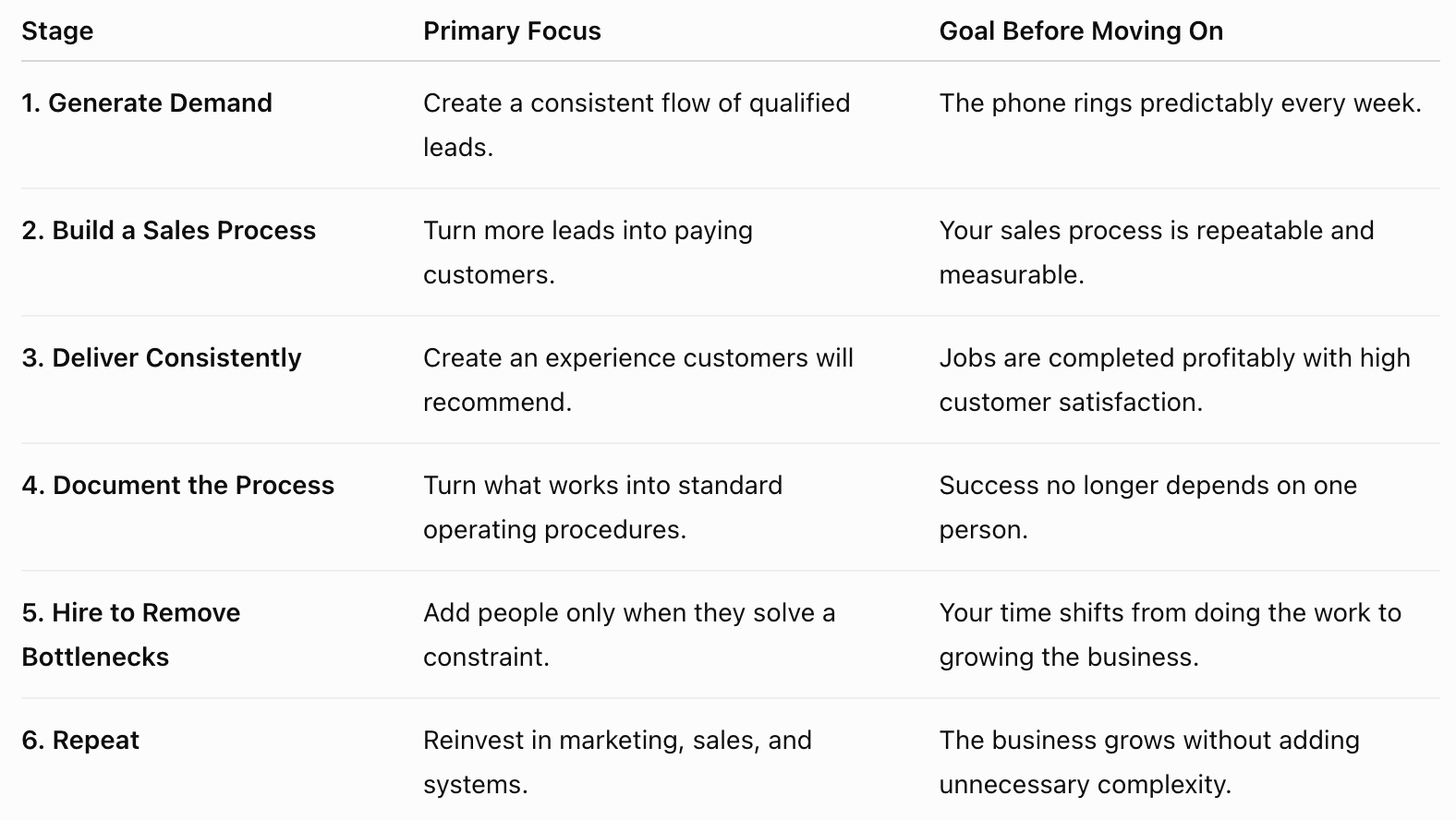
Every new hire, truck, office, or piece of equipment should solve an existing constraint, not prepare for a hypothetical one. That's how I'd build a business that grows quickly without becoming unnecessarily complex.
.png)