

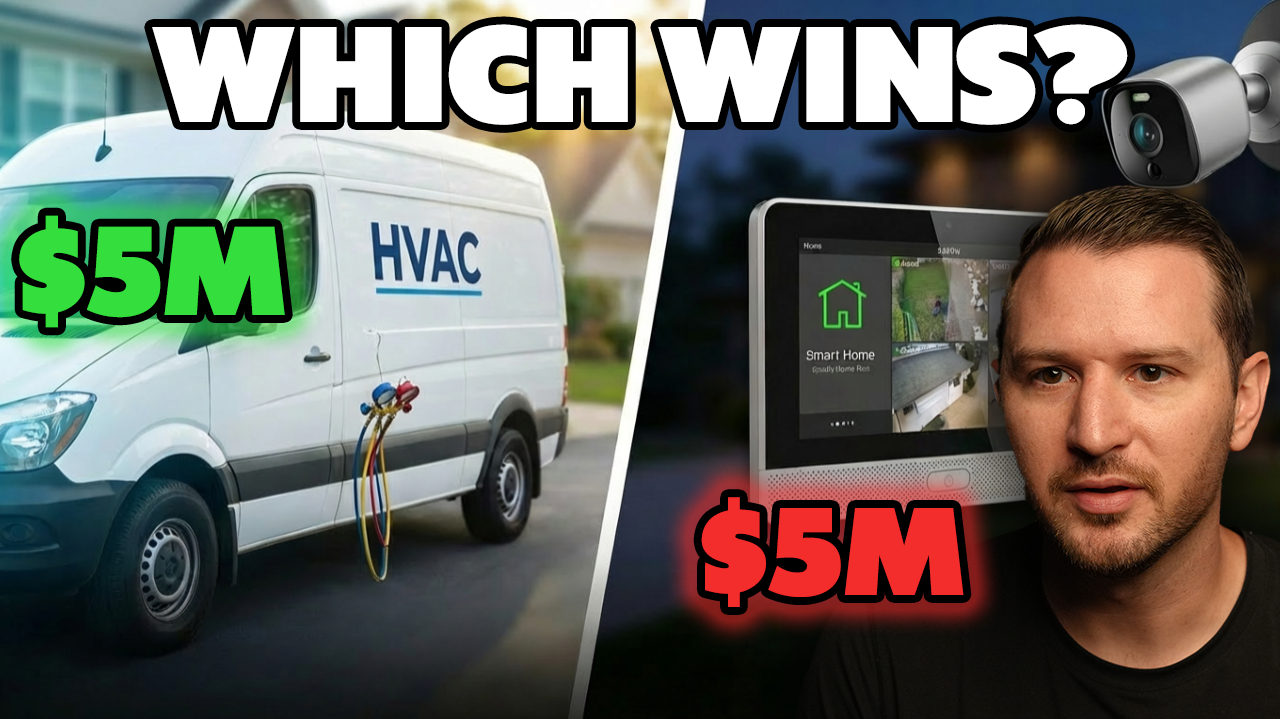
If I’m writing a $5M check, I’m not just buying a business.
I’m buying a revenue model, a risk profile, and an exit path.
After my chat with the guys from Alarm Masters, I came up with a few points that are worth sharing.
1. Recurring Revenue vs. Weather Revenue
Let’s start with stability.
A strong security company can have:
- 30–40% true subscription revenue hitting the bank every month
- 50–60% recurring when you include service work
- 80–90% of revenue coming from existing customers
That means a meaningful chunk of overhead is covered on the first of the month.
Residential HVAC looks very different:
- Membership fees might be 1% of total revenue
- Revenue is still largely driven by service and replacement
- Weather swings can move your year dramatically
In a hot summer, you feel like a genius.
In a mild year, you feel exposed.
If your goal is sleep-at-night cash flow, security has an edge.
2. Technology Tailwinds vs. Regulatory Headaches
Security is a technology-driven business.
Cameras, access control, monitoring, analytics. Hardware cycles every few years. Customers upgrade because the tech improves. AI-enabled cameras create new use cases. Data centers are exploding and speed matters more than price.
Technology drives revenue expansion.
HVAC technology changes tend to be painful.
Refrigerant transitions. Equipment mandates. Supply chain disruption. Regulatory shifts that create chaos instead of upside.
Customers do not upgrade their HVAC because it’s exciting. They upgrade because it broke.
That difference matters.
3. Risk Profile
Every trade carries risk.
In HVAC:
- The unit works or it doesn’t
- The toilet flushes or it doesn’t
- The air blows cold or it doesn’t
The finish line is binary.
In security, it’s more nuanced.
Did the camera capture what the customer expected?
Was the system programmed correctly?
Was the fire alarm inspected properly?
Add life safety into the mix and the stakes increase.
Security has stronger recurring revenue.
It also carries higher liability in certain segments.
4. Exit Potential
HVAC is fully institutionalized.
Large private equity platforms. Billion-dollar deals. Clear buyer pool. Proven consolidation playbooks.
If your plan is to build for 5–7 years and sell into an established roll-up machine, HVAC has a defined path.
Security is consolidating, especially in commercial and fire alarm.
But it is not as crowded yet.
That can be an advantage.
Buying before the capital wave hits can produce outsized returns.
The question is whether you want to follow the wave or get ahead of it.
5. Geography and Demographics
HVAC works almost anywhere.
Every building needs heating and cooling.
Security is more sensitive to:
- Business density
- Commercial growth
- Fire code enforcement
- Technology adoption
A growing metro with strong commercial development makes security more compelling.
A small town with old housing stock can still support a large HVAC shop.
Your market changes the answer.
6. The Real Question
If I’m thinking about long-term stability and recurring revenue, security starts to look very compelling.
Recurring revenue. Service-heavy mix. Stable base that compounds over time.
If I’m buying to scale aggressively and flip into a deep buyer pool, HVAC is hard to ignore.
Both can win.
The decision comes down to what kind of volatility you’re willing to tolerate and what kind of exit you’re targeting.
.png)
.png)