



Operators tend to swing too far in one direction. They either centralize everything and lose what makes each market work, or keep everything local and never build a real system.
The companies that scale separate the two, centralizing strategy and spend, while executing locally where trust is actually built.
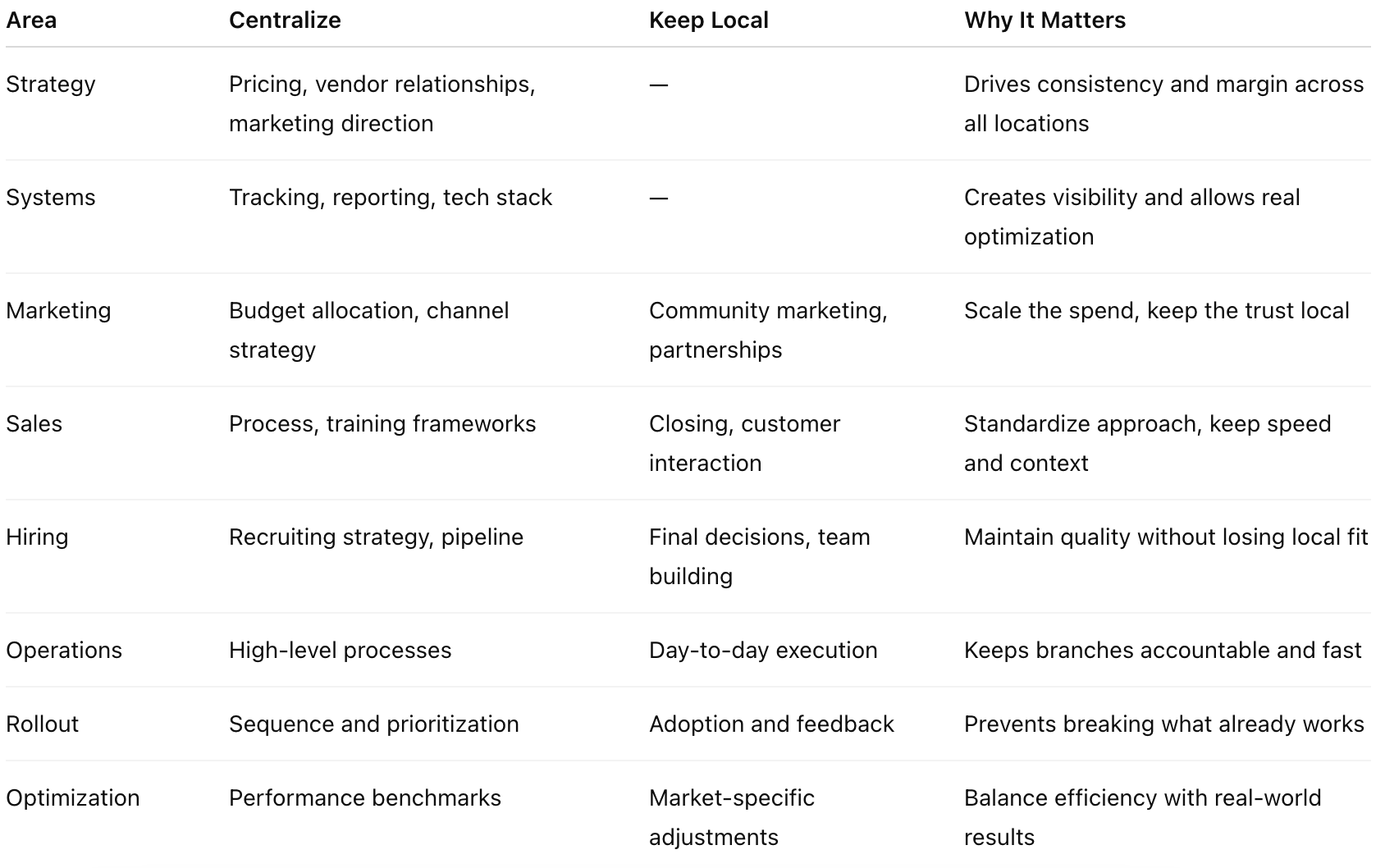
Start by separating decisions from execution. Strategy should live in one place. That means pricing, vendor relationships, marketing direction, and how you measure performance. If every branch is making those decisions on their own, you are leaving margin and consistency on the table.
Next, standardize the systems that support that strategy. Build one way to track leads, one way to evaluate marketing, one way to manage vendors, and one way to report performance. This is what allows you to compare markets, shift budget, and actually improve results over time instead of guessing.
Then draw a hard line around what stays local. Sales, hiring, and day-to-day operations should sit with the branch. Those teams are closest to the customer and need the ability to move fast. When you pull those functions into a central office, you slow everything down and take away accountability.
Roll changes out in layers, not all at once. Start with the highest leverage areas like purchasing or marketing strategy. Prove the lift, then expand. When teams see results, adoption gets easier and you avoid breaking what is already working.
Finally, treat this like an ongoing calibration. There is no perfect split. Some functions will move back and forth over time. The goal is not to centralize everything. The goal is to centralize what creates leverage and leave the rest where it performs best.
Here’s a cheat sheet…

.png)

.png)

