


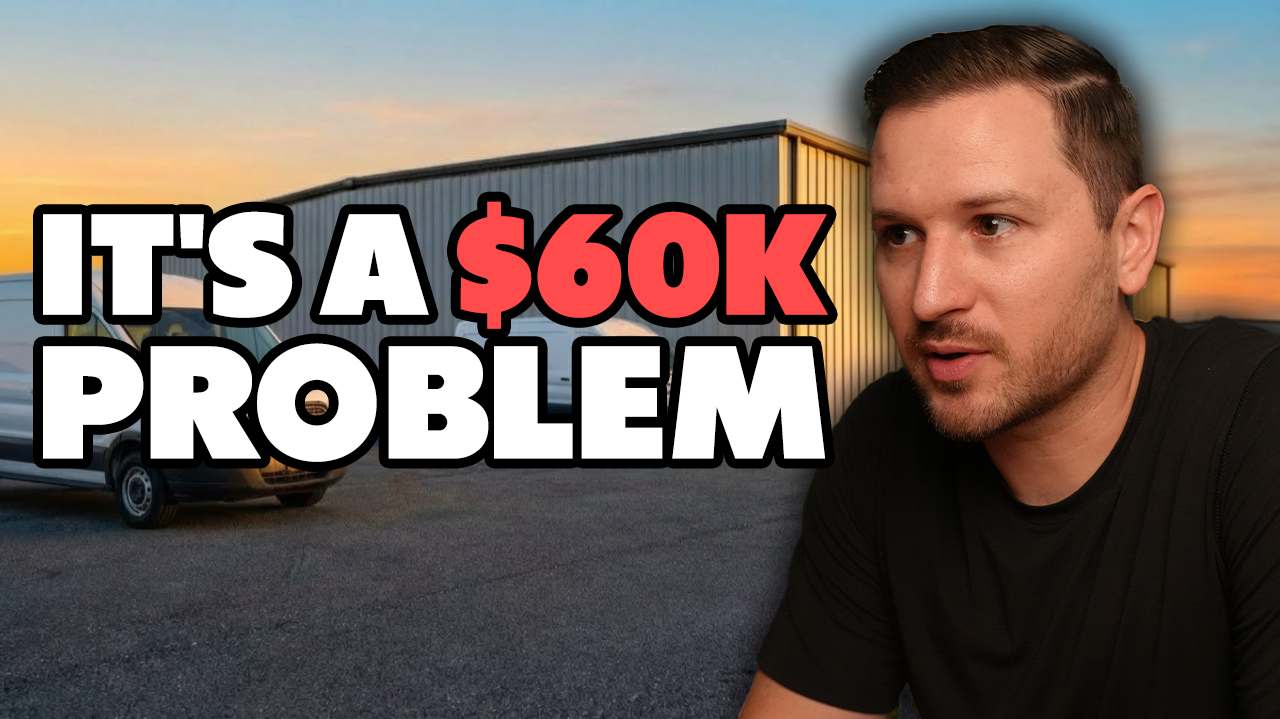
Most operators treat trucks like an ops decision.
They’re not.
They’re a capital allocation decision that compounds across your entire business.
If you’re running $50,000–$60,000 high-roof vans by default, you should be asking yourself a difficult question:
Is this vehicle increasing revenue enough to justify its cost?
If the answer isn’t clear, it’s probably no.
The Real Cost of “Nice” Trucks
A $60K van vs. a $27K pickup is not a small difference.
It impacts:
- Monthly payments
- Interest expense
- Fuel costs
- Insurance
- Depreciation
- Inventory shrinkage
- Balance sheet leverage
At scale, that delta becomes six figures fast.
And here’s the kicker: most technicians can produce the same revenue in a cheaper vehicle.
If revenue stays flat but capital required drops in half, your return on invested capital just exploded.
Constraint Forces Discipline
Big vans create a hidden problem: excess inventory.
When there’s space, it gets filled.
That leads to:
- Obsolete parts from 8 years ago
- Multiple duplicate SKUs
- Lost refrigerant
- “Just in case” stock
- Shrinkage no one tracks
Smaller trucks force you to:
- Standardize truck stock
- Build tight seasonal lists
- Centralize parts
- Turn inventory faster
Constraint improves operations.
“But What About Installs?”
This is the usual objection.
The solution isn’t bigger trucks.
It’s separating the chassis from the payload.
Consider this model:
- Smaller, fuel-efficient daily trucks
- Dedicated enclosed install trailers
- Swap trailers per job type
- Centralized equipment staging
A trailer is essentially a reusable box truck without the expensive engine attached.
It lasts decades.
The truck does not.
Run the Math
Before buying your next vehicle, answer these questions:
- What is the fully loaded monthly cost?
- How much incremental revenue does it create?
- Could a cheaper vehicle produce the same output?
- What is the opportunity cost of tying up that capital?
- What else could that money fund? Marketing? Hiring? Equipment? Acquisitions?
If two $27K trucks can generate more revenue than one $60K van, the decision is obvious.
Action Steps
If you want to tighten this up immediately:
- Audit your full fleet cost per vehicle
- Compare fuel and financing across models
- Set a maximum purchase price policy
- Standardize truck stock by season
- Pilot one install trailer before committing fleet-wide
Don’t default to what everyone else is driving. Default to what makes financial sense.
Your fleet is either accelerating your business or dragging it down.
Make sure it’s doing the former.
.png)

.png)