


The fastest-growing home service companies don't scale by spending more. They scale by making smarter operational decisions.
In this special compilation episode of Owned and Operated, John Wilson and Jack Carr break down one of the biggest hidden expenses in home services: your fleet. They explain why they're moving away from expensive service vans, why the Ford Maverick has become their vehicle of choice, and how rethinking truck stock, inventory, and install trailers can save hundreds of thousands of dollars while making technicians more efficient.
They also dive into the future of fleet strategy, from modular trailer systems and simplified inventory to why most branded truck wraps no longer create a competitive advantage. If you're looking for practical ways to lower costs without sacrificing growth, this episode is packed with ideas you can apply immediately.
In This Episode:
• Why expensive service vans may be hurting your business
• How Ford Mavericks reduce fleet costs and fuel spend
• Rethinking truck stock to improve inventory control
• The trailer system that could replace traditional install trucks
• How fleet decisions impact profitability and cash flow
• Why most truck wraps no longer stand out
• Building a brand that actually differentiates your company
————————————————
🔗 CONNECT
————————————————
John Wilson → https://www.linkedin.com/in/johnbwilson1/
Jack Carr → https://x.com/thehvacjack
Breaking $5M Workshop → https://www.ownedandoperated.com/upcoming-events/oao-workshop-breaking-5-million
————————————————
💰 SPONSORS
————————————————
QuickStaffers
Hire trained HVAC and plumbing CSRs without the overhead of traditional hiring. Save $500 on your first placement with Quick Staffers: https://www.quickstaffers.com/
Breaking $5M Workshop
Join John Wilson and Jack Carr in Akron, OH for a hands on workshop built for home service owners ready to scale past $5M. Get the proven playbook, tour Wilson's operation, and connect with other growth minded contractors. Register here: https://www.ownedandoperated.com/upcoming-events/oao-workshop-breaking-5-million
Yelp
Looking for more qualified leads beyond Google? See how contractors are using Yelp to reach homeowners who are ready to book and diversify their lead generation. Learn more: https://business.yelp.com/campaign/ownedandoperated/
More Ways To Connect with O&O
John Wilson, CEO of Wilson Companies
Jack Carr, CEO of Rapid HVAC
📌 Disclaimer: Some links may include UTM parameters or affiliate relationships, meaning we may earn a commission if you make a purchase. Episodes may feature sponsors, but all opinions expressed are our own.
Speaker 4: 00:00
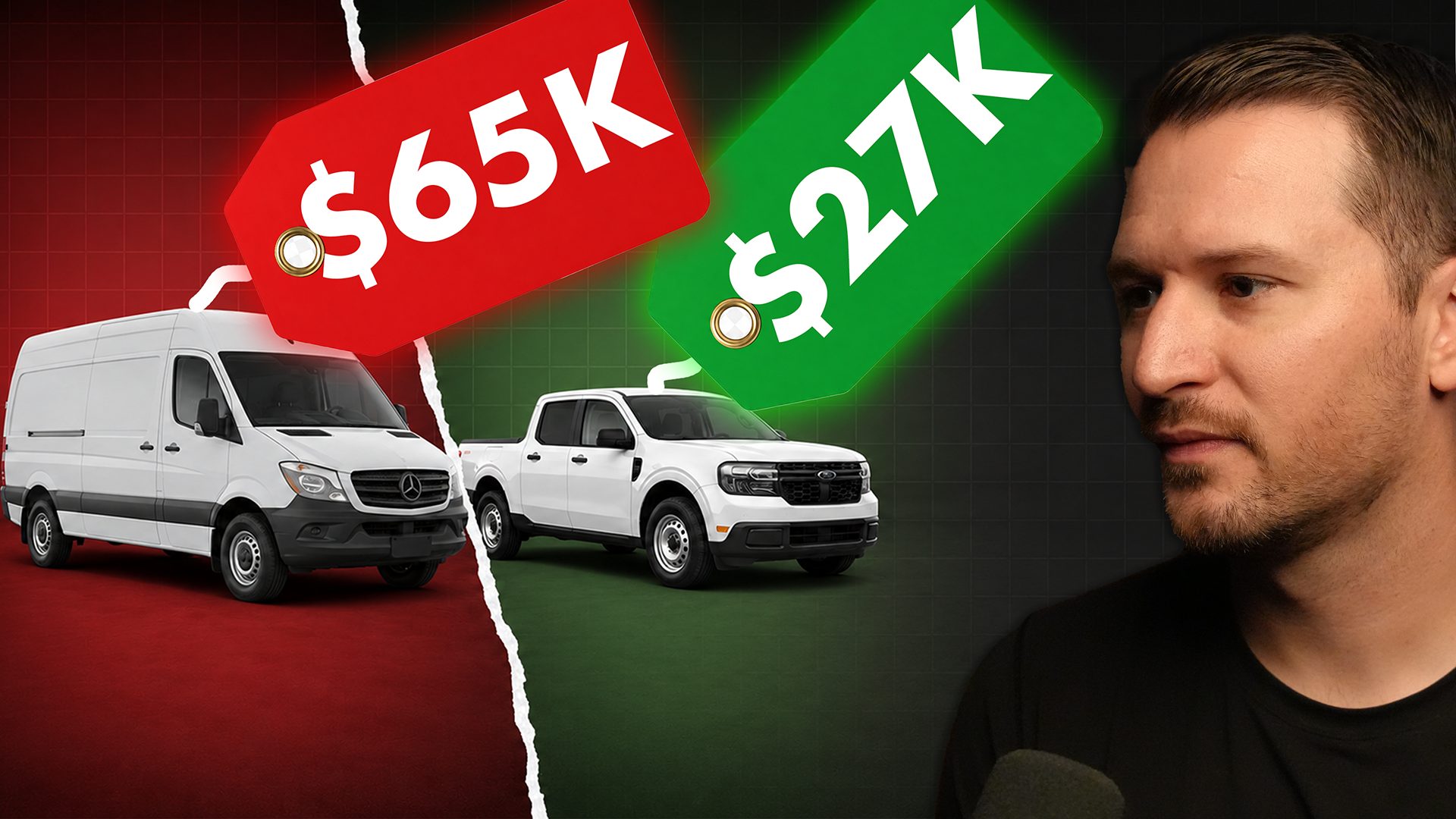
The vans are just too much money. It's like $55,000 to $65,000. You can go get a Maverick for like $26,000, $27,000. I love Mavericks. Why am I sending this guy in this $60,000 truck when a $27,000 truck will get better fuel economy and be cheaper? What if I told you you could burn $50,000 and get absolutely nowhere? Today we're talking truck raps.
Speaker 1: 00:27
Ooh, and I heard you have a hot take opinion.
Speaker 4: 00:31
20 years ago, that set you apart. It does not set you apart in any way at all tonight. Actually, you would probably be more set apart with a white unmarked van than any other vehicle with like an animal logo on it. So we we started doing Mavericks. We started doing pickups, I think, two years ago. Um, I want to say half our fleet is pickup nows. And it's we the vans are just too much money. Uh like we're buying these high-roof vans and it's like $55,000 to $65,000. But you can go get a Maverick for like $26,000, $27,000. So we started switching over purely for cost. We're like, oh, why am I why am I sending this guy in this $60,000 truck when a $27,000 truck will get better fuel economy and be cheaper? Uh so yeah, we switched at the tail end of COVID and it has been huge. I don't think we bought a a van for uh uh three years now. Most home service companies don't stall because of demand. They stall because they run out of good people. Finding solid help fast is hard, especially in this industry. And that's where Quick Staffers comes in. They help home service companies build reliable virtual teams that actually understand how the trades work. Quick Staffers provides vetted, remote staffed who are already trained on Service Titan and use proven SOPs, the same as the ones that I use at Wilson. These are VAs you can plug in from day one to handle customer service, lead follow-up, scheduling support, and a ton more. They've been a huge help in scaling my team without the usual hiring headaches. Check them out at the link below.
Speaker: 02:18
Yeah, we haven't bought a van for the last three years. And so our setup, because I get asked this a lot specifically, is we go with a white maverick. We usually try to get the year before. So uh what happens is like a lot of these larger groups, pest control, pool routes, whatever, they're buying 40 of these at a time or 30 of these at a time, and they don't necessarily actually so they order 30, I should say, but they only buy 28. And so we pick up the last two that have been sitting on some lot in in kind of some off area of Tennessee, and our guy at Ford knows that's what we're looking for. So we get a 2024 white Ford Maverick. Uh, I I don't really have a preference on eco versus um or hybrid versus non-hybrid. We have a mix in the fleet. Some people do have preference just because um, like there's some known issues with the hybrid models, they're a little bit more difficult to work on because they're a hybrid, right? Um, that being said, overall we haven't had too many issues in general with them. We've had one recall, um, but we get that. Then about 2627, we have the DCU um cover by ARE, uh, which is like the three-door um yeah, what do you call this? Uh, toppers with the roof rack already built in.
Speaker 4: 03:37
I think I think that's what we're missing because that gives you the ability to put like a full water heater in there. And we're using the tonneau covers, which um you just can't put as much. Exactly. But we also we had to do that during COVID because it used to take 30 weeks to get the thing that you have, because I think we have eight or nine of those, and like we just literally couldn't. Yeah. So we ended up with tonneaux, and then we ended up sticking with them.
Speaker: 04:02
But those are nice though, because like that's where we can put we put the the tubes that you put your your other pipes in, and then we put a ladder, a like little giant ladder on it, and like that's what sits on the top of the rack, any kind of you know, any kind of material that's oversized, we we get. But overall, what the only thing we're changing, which we were, you know, as we're kind of learning our systems, is we were doing the rat packs, which are just like pull-out drawers inside the bottom of that. Um, that and I don't know the the size, whatever the bed size is like five by four or whatever. Um, but we're actually moving away from those. So I don't want to say that that's what we're using, but most of them do have that because those are about a thousand bucks, and we can buy three Milwaukee packouts, like brand Milwaukee packouts for that same cost.
Speaker 4: 04:50
Well, I just found out that Milwaukee packouts have a full like truck stock system. So we bought a business at the end, yeah. What does that like look like? Dude, I don't even freaking know. Like it it well, it's the packouts, but there's a way that you can hang them on the wall of a van.
Speaker: 05:10
Yeah. Oh, yeah, I've seen that. I didn't know that.
Speaker 4: 05:13
Oh, I I have never seen that. So we we yeah, we bought this business and they have six plumbing vehicles, and all of them have Milwaukee packout like it's it was freaking awesome.
Speaker: 05:23
That's the reason to buy the plumbing business in itself, is that you got six Milwaukee packs. Oh, yeah.
Speaker 4: 05:27
I was like, oh, this this alone, you know, that you've got me.
Speaker: 05:30
But yeah, but yeah, so that's what we started doing. So our our our fleet, yeah, uh, because like the idea behind it, right, is and we've talked about this a lot, so I'm not gonna beat the dead horse here, but like the idea behind going to um Mavericks, uh, a big portion of that is reduced inventory. Like you can't store $30,000 in inventory, which is a catch-22. You can't hide, but realistically, I don't even feel like it's a catch-22. Like, you just can't hide multiple motors and multiple things from 10 years ago, six or seven drums of like 407C and some random R, you know, 132 for this one job you had 10 years ago. Like, you have to be uh meaningful and thoughtful about what inventory you have on stock. But so we're able to do a couple pack outs now instead of the rat pack, and then our only rule is like, hey, you keep your tools inside the truck, like all the nice tools, like the the uh pump down system, the uh recovery machine, your your gauge set, like all that kind of stuff. Just keep that in the truck, and then in the back is where you keep you know roll of copper and um any kind of tank. We have a little tank strap that we do to the back wall for uh our 410A, yeah, uh and R32. And like it is perfect. We we had the ice storm, nobody got stuck. We were able to run a ton of calls, yeah. We had very little issues with uh inventory or like crashes, no problem. And we're we're giving into this. We're all in for like 33 per per truck, so that's that's not the harebrain idea. So that's just setting the stage because everybody asks. I love it, I think it's the best thing ever.
Speaker 4: 07:13
I I think we're in the we're in the 20s with it. Like we brought on 20 last year, five or something the year before. We have a ton of rangers, we have a ton of Tacomas, but we ended up with Mavericks because they're so much cheaper. Uh the also great gas mileage. I I definitely think it's just like the right decision, yeah, to be honest. It is the most like cash efficient decision that you can make.
Speaker: 07:34
Yeah, I mean, we started it's half the price. Yeah, we started just for like our salespeople who are running around in in like F-150s, like an F-150s.
Speaker 4: 07:44
Yeah, it's crazy. Well, we we ended up doing the Chevy Trailblazers for salespeople, and those are like $17,000 brand new. That's pretty good too. So that's great.
Speaker: 07:58
Yeah, buy Mavericks. Hello, Chevy Trailblazer.
Speaker 4: 08:01
So yeah, for salespeople, we started putting them in. I mean, it it's still an SUV, but yeah, it was uh 17 grand. Yeah, I mean, with tax, it was maybe like 20.
Speaker: 08:11
And and so the harebrain idea, John, is yeah, I'm ready. We want to move away from vans and trucks all together or vans and box trucks altogether. Yeah. And so the way that we are thinking about doing this, right?
Speaker 4: 08:25
And I think the big the big pushback is gonna be install. The big pushback is that.
Speaker: 08:30
Yeah, admittedly, like you cannot fit anything else in the back of the truck. There's no like you maybe get a evap coil, like there's nothing that can go back there that's over a certain size. Yeah, they're able to to carry water heater around because we have custom fab racks that sit on the back of the tailgate. Um, but outside of that, like you cannot carry an HVAC unit, and we have to do five-ton package units here in Nashville. So the what we're thinking is the Mavericks can tow up to 4,400 pounds, which is about I mean, you can get a pretty big trailer for 4,400.
Speaker 4: 09:07
It's that's two other Mavericks. One Maverick can tow two other.
Speaker: 09:14
And so what we're thinking is like, what if we created a system and we're working on it right now? It's and the system is instead of Milwaukee packouts, for our installs, we're doing trailer packouts where you have an extra $2,000 enclosed trailer, a six by ten enclosed trailer that can fit, not only fit a package unit, but sits lower and has the drop-down gate. So they're not actually lifting anything up and over. It is full roll-in, roll out. And um, for two $2,500 an outfitting on a brand new enclosed trailer, six by ten trailer, it can haul that plus a five-ton gas package unit, which is only six, five, six hundred pounds more, still be underweight, and then you could outfit that thing with all the gas fittings and everything you need. And then once that one's done, at the end of the day, you pull it back in and they go and grab the next trailer. So it's really just disconnecting trailer, hooking up new trailer, and that's your pack out. So that's my crazy hairbrand idea.
Speaker 4: 10:17
Okay.
Speaker: 10:18
What do you think? Where am I missing something?
Speaker 4: 10:20
I think yeah, I think the only thing I don't like is driving with trailers is a skill. And some idiot's gonna jackknife that thing. Uh so I don't love that. Um you'll probably have more accidents. So you'll have to noodle on that. Maybe like one extra year. I don't know. Um what I what I like a lot is it's the same reason I like box trucks. Like, you can just change the box, but keep the chassis. So all the investment into the box, like into the trailer, like you can a trailer can last like 30 freaking years. Like, it doesn't matter. Uh, so that's kind of nice. Is useful life is a long time. Uh, so I think I like that a lot. We we've talked about doing this before. Um we talked about it. Well, we have one for excavation, but we've talked about doing this for boilers, I think, and maybe generators, like there being like a trailer that goes and handles generators. Uh, but we obviously have not done it. If you're trying to break through the five million dollar mark, this is the workshop that I wish I had when I was growing Wilson. From September 15th through the 17th, Jack and I are hosting our one of our famous Breaking Five workshops at our headquarters in Akron, Ohio. You'll see our operation firsthand, you'll sit in our live sales huddles, you'll tour the shop, and we'll break down the exact flywheel that we've used to scale. Every workshop that we've done has sold out. So if you're serious about building your business, grab your spot now at the link below before it's too late.
Speaker: 11:57
Yeah, and so the way I try to look at that, right? So when you're talking about accidents, you're really talking about like he backed into something or he jackknifed something. And the way I look at that is the damage or took a corner too sharp. Yeah, the damage that you generate from one of those accidents, is it $30,000 equivalency to paying for a van? And not to mention, like they also screw up those vans in the same exact way by jack not jackknifing it, but like taking a turn to tighten a gas station. And now your your nice white van has a yellow stripe across the side. So like I don't think that that it's equivalent to one to zero. It's like one to point three. Um yeah, and so that 0.7 of risk, how much is that worth? But that's what that's the way we're moving, is we're gonna move full so you'd have three, three, or like two or something? Three. We're gonna think about three enclosed trailers. The only downside, and we're gonna we're gonna do the same for water heaters. It's like, hey, this is our water heater um packout van or pack out uh trailer.
Speaker 4: 12:59
Uh the well, I feel like you could almost do that in the same because I mean HVAC guys can put in a water heater.
Speaker: 13:06
Uh either way, yeah. I mean, I I think that it has gas fittings. It has a like an HVAC packout is very similar to a water heater packet, right? There's not all the tools are in the back of the truck anyway, so it's not really again, it's not um the trailer is just the equipment and like the equipment installation, which is gas pipe, whip.
Speaker 4: 13:25
How big is the trailer?
Speaker: 13:27
Uh six by ten. That's not bad. It's not bad at all. It's single axle.
Speaker 4: 13:32
Um and you could you could honestly probably pull that with something like a trailblazer. You might not even need a mouth on that. I like it to pull that.
Speaker: 13:42
I like it that it runs kind of like a billboard, so it runs like a box truck still, right? In the sense of when you wrap it. Yeah. Um, and then the only thing that I am discouraged on is there's I'm 100% sure that there is no way that we can pull excavation equipment with a maverick. Um so the the No, not with the trailer you have. I mean, that's a big trailer. Well, I just mean like in general, like that that that excavation needs like an F250 minimal to pull that thing.
Speaker 4: 14:11
So I mean we we have a we have a 350 pulling ours, but that was a you know, the first time we bought a uh excavation like dump, it was a 750. That thing was humongous. Um, and it was like 125 grand. And then we downgraded to uh a 350, and that I mean that thing's been great. It's like it's a big truck that happens to have a dump back. It it's good. Like I we'll probably get another one, yeah.
Speaker: 14:38
And so that that's my only downside. But uh again, it's really for excavation only. We already have the the truck, so we're not getting rid of that one.
Speaker 4: 14:46
Um, and for the most part, so full mavericks, bunch of trailers. I kind of I'm kind of into it.
Speaker: 14:51
I I think I'm into it. Full Mavericks, bunch of trailers. Like our Mavericks already have like a lot of them, already have like 50,000 miles on it. But we saw we also saw meaningful change to our gas.
Speaker 4: 15:02
Like the amount of gas we spent is our gas is down, our gas is down too. Now I think I think that um I think that gas prices changed. I'd have to look, but in 2024, we spent $456,000 on gas, and in 2025 we spent $298. Yeah. So like $157,000 of a difference. Like it was enough that I remember the numbers because I was like, what the hell happened to this line? I don't yeah.
Speaker: 15:30
So we're about the same. So I think it was a bit of yeah, gas pricing went down, but also there's some level of uh drop.
Speaker 4: 15:38
We controlled it from it's it's one of the few things you can do to control gas prices.
Speaker: 15:41
Yeah. I mean, I drove, so I I had to run some calls this last week because of Snow Mageddon. And uh man, I was going some distance. I drove for like three or four days without having to fill that thing up, and I'm talking about like a hundred miles a day. Like it was wild. And then when I filled it up 30 bucks, I'm I'm blown away, man. So Maverick's a big fan.
Speaker 4: 16:02
Um well, I'm I'm trying to convince Brandon to do the same. He's like, dude, we can't, but I've slowly we've actually been able to pull it off because I've told him I'm like, so the way I'm gonna get you onto this is I'm just not gonna buy any more vans. Like, we're not. So you're just uh so we've you just you're gonna we're like forcing him in.
Speaker: 16:21
You're just gonna wait till I have a an install trailer rolling around, and then I'm gonna take some pictures and then you're gonna finally pull the trigger. Yeah, Brandon will be okay with it.
Speaker 4: 16:29
It's gonna be it's gonna be great. But yeah, so we've we started moving like primarily pickup a couple years ago. And yeah, I I don't think we've maybe bought one van in the past three years that wasn't uh like a cheap pickup because like I don't want to pay $50 freaking thousand dollars. I think my other solution, and that this is something that I I think is kind of funny. So, like when we first started off in the business, we were buying used vans, and like the only measurement for I'm gonna buy this van is was it below 20 grand? Uh and like we moved in 2019 to enterprise and we've been doing that whole shindig. And now we're like trying to figure out bands again. And I'm like, I don't want to keep paying $60,000 for a vehicle. Like, I just think that sucks. I think that uh, you know, when I started off in enterprise, like the Chevy vans were like 30 grand. It was 2020, 2019, 2020, like it didn't double yet. So yeah, so so I started calling some friends, and I mean, I talked to people running hundred million dollar businesses, and they're buying twenty thousand dollar used vans. Like, so it it would, it was just, it was like, man, okay, maybe we should have just been doing that the whole time. Uh, because I think it is it's such a drag to the business going and buying these, like it's just a bad balance sheet decision. Like, hey, I'm gonna go buy a $60,000 vehicle that's also worse on gas and probably more repairs. Yeah, I mean, like, and I'm gonna lose more inventory in it. Like, it's a it is a bad business decision.
Speaker: 17:55
I think the only side to it that is a good business decision, which I will give up, is like the ability to repair anything on site. You do not have to put in any extra labor or time or material into something. But again, especially in HVAC, like plumbing is a little bit different just because um I think that you can you can actively have a better truck stock list to manage what is on a house, right? Because like pipes all the same, outdoor fittings, like a hose bib, yeah, is going to be a hose bib, no matter what brand it is. Like customers don't care. The problem comes into play is like once you start running into warranty and non-warranty OEM versus non-OEM on Lennox versus Train versus Goodman and like so how it it's always blown my mind to me like how how do people try to stock for all those contingencies when it just doesn't make sense to me? You're going to have to run to the factory anyway to get that warranty board, or otherwise you're installing a non-warranty thing on a warrantied system, which then yeah.
Speaker 4: 18:59
I think we we came up with like a two thousand dollar per truck per maverick H truck HVAC service system, and it was very like generic parts driven. Um so that's been good for us.
Speaker: 19:12
Let me ask you a question about that. Do you guys do it is that for all year, or do you guys do two separate ones?
Speaker 4: 19:18
I think it changes by the season.
Speaker: 19:20
Yeah, because that's what we did. Because I was gonna say 2000 would be hard for all year, but we are about 2,000 a season. So we do 2,000 in cooling and about a little more in heating because we carry a couple different sets of inducers just in case. But like you can't again, same thing with inducer motors, is like all of them are very specific to the type of unit and the brand of unit. There's really no OEM that fits all, and um it makes it it makes it difficult. But like we whether you had a truck that was like a K KV or whatever they're called, topper that was a hundred thousand dollar truck with a bunch of stuff in it, like you still can't fix that problem. And now you're spending the gas to get up to the warehouse and back, where you know, at least in the Maverick, you can do it fast. So yeah, it's a very interesting uh segment. But in like plumbing again, I think that you can truly have a better impact. Um, and then electrical, we're still and electrical is super easy, like you can do install.
Speaker 4: 20:17
The only issue is generators, yeah. But you can get a lot done in a Maverick in electrical.
Speaker: 20:22
I was just looking up though, like a 22 kilowatt whole home generator is still only 600 pounds, like crated 600 pounds with transfer switch. So that would still fit into the back of a yeah, you could do the trailer of a trailer.
Speaker 4: 20:36
So yeah, no, you could do a trailer for sure. Might even might even be easier because then otherwise, our like we have a truck that has a lift gate and we have to use the lift gate truck for generators because it's 600 pounds.
Speaker: 20:48
Yeah, so I mean being able to roll it out, I think, is a huge win. Um yeah. Overall. So you're you're on team Maverick then.
Speaker 4: 20:56
Oh, yeah, fully. Because it mainly just like I don't want to spend 50, 60 grand on a vehicle. Like, I just won't. Not not even I don't want to, I'm not going to. So if I have to buy a van, it's gonna be used. So yeah, my motivation is if I'm buying a vehicle, it's gonna be under under 30 grand. I'm back on that. I'd rather a brand new Maverick than a used van, but I would take a used van. But like I'm not gonna spend more than 30 grand. Here's a stat about Yelp that I bet you didn't know. When millions of people ask AI like ChatGPT, Perplexity, or any of the others what the best home service provider is, Yelp recommendations show up three times more than Angie, Thumbtack, Home Advisor, Better Business Bureau, and Nextdoor combined. And here's why that matters to you 91 to 97% of those searches do not include the business name. The homeowner hasn't picked anybody yet, and they're deciding right now. And Yelp is where they're getting their answers. These aren't low intent browsers. Over half of Yelp's 76 million monthly audience earns six figures and owns their home. Varga started a five-star HPC on his own in Dallas, and he turned on Yelp ads, and they hit 30% year-over-year growth with $650 revenue per call. And he grew his monthly leads by 444%. If you want to own the moment when homeowners are making their choice, you should be checking out Yelp. Start earning your share on Yelp's 350,000 daily home service leads by going to business.yelp slash owned and operated. Today we're talking truck wraps.
Speaker 1: 22:31
Ooh. And I heard you have a hot take opinion.
Speaker 4: 22:38
I just think like maybe it is. I don't know. So in 20, I'm gonna, I'm gonna, I'm gonna hearken us all back to the 2010, 2015.
Speaker 2: 22:50
The good times. The good times.
Speaker 4: 22:51
The good old the good old days, you know, Obama was in office, which I don't know.
Speaker 2: 22:59
This is getting hotter and hotter. Yeah, yeah, yeah.
Speaker 4: 23:02
And um, so you know, 10 years ago, 15 years ago, the service industry had like a bad rap. Yeah. Like uh unprofessional, and um and like the white van, the you know, the plumber's crack. There was a lot going on with the reputation of the service industry. So back in the early 2000s, a couple of franchises and brands wanted to set themselves apart. Mr. Rooter, Roto Rooter. Um, I've I there's some old newspaper clippings uh that we have somewhere around here, and they're from like 2001. And it was Roto Rooter, and it's like it was sort of a tongue-in-cheek, like making fun of the industry. Like, how do you know you have the right plumber? Well, does he smell like he drank his breakfast? Does he is his ass crack hanging out? And like this was in the newspaper, and it was like five different things. And it was like, is it a clean mark truck? And it was it set themselves apart from the industry. Was like, hey, we are clean plumbers. Yeah. And that was a tagline for I think champions or something out in California was hey, we're the clean plumb or George Brazil in Arizona. They're a $200 million business now, I think. But hey, we're the clean plumbers. We smell good, like we're the smell good plumbers, whatever. And in the early 2000s, that really set you apart. Yeah, the marked wrapped truck was interesting and unique and a little bit different. And um, like today, that's just literally not the case at all. And I think my hot take on the wrapped truck is 20 years ago, that set you apart. It does not set you apart in any way at all tonight. Actually, you would probably be more set apart in 2026 with a white unmarked fucking band than any other vehicle with like an animal logo on it.
Speaker 5: 25:00
Yeah.
Speaker 4: 25:00
Because everybody's got the animal logo. So, like, yeah, I don't know. Like, there's a company in our market where everyone thinks that we bought them because our brands look roughly the same. Like they did their brand a couple years after we did. Yeah, totally.
Speaker 2: 25:14
I'm like, yeah, I totally completely own them. More people are searching for you now because of them wrapping their truck.
Speaker 4: 25:21
It's great. But like it's blue, it's orange, there's a guy, you know. Yeah, and um, but it's it's overdone. Yeah, so now we're at the point where like, hey, every company has this robust branding package, it's all the same. Yeah, like there's a caricature of and mine too. Like, I'm throwing punches at myself, uh, where it's like, hey, there's a guy, there's a brand, it looks kind of retro. And like, yes, it looks good, yeah. But if the reason that people started wrapping trucks and branding in this way was because it set them apart.
Speaker 3: 25:54
Yeah.
Speaker 4: 25:54
And like, hey, core, core concept here, like that's why in 2026 it doesn't set you apart.
Speaker 2: 26:00
Feels like it's kind of like websites. Like early on, that was like you have a website and it's well designed. Oh my gosh. Oh my gosh. Now, if you don't have a website and it's not, yeah. And the difference between somebody who has like the most perfect website that's super sexy and super designed, and the and just a website that helps you get your job done, yeah, is not that big of a difference.
Speaker 4: 26:21
Yeah. So I I think my hot take is it doesn't set you apart the way that a lot of the material that's out there says it does. So like there's podcasts, there's books. Look at when they were written. Look at when they were published. If it was published in 2015, hey, this is a different like in 2015, most companies still didn't have wrap trucks. Yeah. In 2026, everyone has a wrap truck. There's no like I don't often find a brand with like the name without a caricature. Like there's always a character, there's always the name, it always looks like a you know, 1960s or 70s or whatever. Like mine looks like 1950s. Yeah. Um, so yeah, that's the hot take.
Speaker 2: 27:06
Is your more more of your issue with the branding of it specifically or track rubps wraps itself?
Speaker 4: 27:12
So I think the branding specifically is where I have an issue because everyone looks the same. Well, everyone looks the same thinking that they're different and they're paying a shitload of money to do it.
Speaker 3: 27:23
Yeah.
Speaker 4: 27:23
Like if the goal is to set yourself apart and like have a brandable brand company that you can run ads behind and not look like somebody else. Like this other company in my market is spending $20,000 a month to be told that they look like me.
Speaker 3: 27:40
Yeah.
Speaker 4: 27:40
Like, what are you doing? Yeah. What are you doing? Yeah. Like it's just like, come on, I would probably change your colors. Like something. It's a little, it's a little silly.
Speaker 3: 27:50
Yeah.
Speaker 4: 27:51
Because like of the two of them, like, we're, I think 15 times their size. Yeah. So like no one's thinking I look like them.
Speaker 3: 27:58
Yeah.
Speaker 4: 27:58
Right. So they have five trucks and we have 100, whatever. I don't even know. But yeah, so I I think I have struggled, I struggle with everyone looking the same. And um, you know, when we were doing our branding process in 2020, 2019, I think it's 2019. Someone that uh I was talking to at the time, which was kind of like I dismissed it at the time. Uh, but now I'm like, actually, that was probably a good point. Was she brought up Stanley Steamer? And Stanley Steamer, I don't know if that's a nationwide thing or just around here, but yeah, so like their trucks have not changed in a hundred fucking years. No. It is like this weird sort of pukey diarrhea orange with Stanley Steamer, and like that is it. Uh, and if you look at the big, you know, Rotor Rooter basically invented truck wraps in our industry. And if you look at their most recent trucks, they have simplified it substantially. So they've everyone went crazy busy with all these truck wraps and like lightning and shit. And like everyone's got a dog with a wrench. Yeah. And then now like the biggest leaders in the industry are re-simplifying the rap to color name. Yeah. Because now the simple rap is the thing that stands out.
Speaker 3: 29:15
Yeah.
Speaker 4: 29:16
Because everyone's got the animal or the you know, the human whatever.
Speaker 3: 29:19
Yeah.
Speaker 4: 29:20
Including us, right? Yeah. So I'm throwing, I'm throwing rocks at myself. But yeah, that's my odd take.
Speaker 2: 29:24
I feel like there's a couple good ones that I can think of that I feel like stood out. Even on the animal one, I think we have uh uh call the otter guys, yeah.
Speaker 4: 29:31
Aaron's Aaron's company, yeah.
Speaker 2: 29:33
Yeah, I feel like that's really good branding because you're gonna call them, right? Yeah, um, but my favorite's gotta be called dad. It because it it it builds like some like warmth in me. Like, yeah, I want my dad. Yeah, uh, my father-in-law is the one that comes over and fixes all the stuff in my house.
Speaker 4: 29:46
Anyways, that's so much more that is a brand, yeah, brand. And I think that that's like well done. Like what Matt and his team has done is is or and Dustin with mother plumbing, uh similar. Like, I think that there's like more going on there that is really well done. And that's different than what I see most people do, which is here's my truck wrap. And I've got some lightning and like my robot guy with you know, and but like nothing else changed. It's just like here's my robot and my name. Yeah, we'll keep you cool, or whatever the line is. Um yeah, it's just undifferentiated. Whereas like, yeah, mother plumbing, that's that's different, that like brings warmth. Like, there's a lot going on there. So I'm not I'm not like slamming on brand. Yeah, I'm slamming on making your brand look exactly like everyone else's brand. Yes, because you've defeated the purpose of this investment. Yeah, like if you're paying $2,000 a truck or $3,000 a truck, that's a big investment.
Speaker 3: 30:43
Yeah.
Speaker 4: 30:44
And why would like why did this guy down the road make his brand look exactly like my brand? Like it doesn't make like maybe he gets a couple leads because people think he's me, but like it is weird.
Speaker 2: 30:58
Yeah. So wrapping trucks, though, specifically, yeah. Um, you're cool with like you like that, it's a good idea. Yeah, just like if you are be different, be different, be different.
Speaker 4: 31:09
Um, and and like having the guy and having the animal is no longer different, yeah. Like it's just not. I think it depends on like who's running the ship. Like, sure, but now you know, PE comes in, they buy if if it's an unbranded or like if they don't have a guy basically on their trucks, like they come in and they they put together a robot or dog or whatever. And um, like they've run the playbook over and over again, and it's it's they're just machining a fake brand. Yeah, they're like, all right, we're gonna go here's a dog, and we kind of want blue and orange and maybe red, and let's put it over there and let's give them a wrench or a pipe or you know.
Speaker 2: 31:47
Or or my favorite is the where they try to combine something cold and fire together. So it's like the ice or it's like the snow and fire, and it looks like literally coming out the same way.
Speaker 4: 31:56
Yeah, it's some like pee guy. Yeah, just like oh, we need a brand. It's yeah, you're part of my checklist. Uh, is I have to have a robot. And um, so yeah, I I think undifferentiated. So I think, yeah, wrap the trucks, like pop off. I think it should be very different. And I think that very different in 2026 is simple. Yeah. Because in 2020 or 2015, wraps were new technology. Yeah. And so people had like complicated wraps.
Speaker 3: 32:24
Yeah.
Speaker 4: 32:25
But now, like monocolor, I think, is awesome.
Speaker 3: 32:28
Yeah.
Speaker 4: 32:28
Uh yeah, Stanley Steamer is like a funny brand to me because the color is unique. Yeah. And it's just Stanley Steamer. Or like Surpro is another one. It's a very simple rap. It's like fucking green, yeah. Surpro.
Speaker 3: 32:41
Yeah.
Speaker 4: 32:41
Uh Mr. Rooter, Rotarooter, they're both doing the same thing that I said. That's like they're going to like dual color or maybe monocolor. Yeah. And like Mr. Rooter, and like that's it. But it like makes them stand out more than the busy robot, you know, dog guys. Yeah.
Speaker 2: 32:57
I think that from a branding standpoint, you can do it right and you can do it wrong. Um I think Porsche is a really good example of someone that keeps iterating, but it's literally the same thing, just slightly tweaked and it looks good. Yeah. Whereas I think it was Jaguar that came out with a brand new branding. And it's just like, are you a tech bro? Like, what are you doing? It was really weird.
Speaker 4: 33:14
It's terrible. Yeah, it was really weird.
Speaker 2: 33:17
Yeah. My hot take is that branding isn't actually going to drive you more leads, but it'll help you close more deals.
Speaker 4: 33:22
Yeah, well, I agree with this. Yeah.
Speaker 2: 33:24
Because once you're in person, then I think the the difference between you tucking your shirt or not, making the person there feel comfortable. Do you smell like cigarettes? Yeah. Or did you, you know, brush your teeth before you came into my my house? I think those small things, or even like the people that like um will put like the little hair gnats uh on their shoes to make sure they're not tracking on anything.
Speaker 4: 33:48
Well, this is back to differentiated.
Speaker 2: 33:50
Yeah.
Speaker 4: 33:51
So like, but you know, as as the competition gets more and more fierce, uh every every year, month or day, or whatever you want to, however time period you want to think, things that used to be different are now table stakes. Yeah. So 20 years ago, shoe covers were not a thing.
Speaker 3: 34:11
Yeah.
Speaker 4: 34:11
And then somebody was like, hey, I'm gonna start wearing shoe covers.
Speaker 3: 34:14
Yeah.
Speaker 4: 34:15
And then the consumer started expecting it. And now what do you mean you don't have shoe covers? Like that would be that that would be insane to me that someone like isn't putting on shoe covers while that's like very 20 years ago.
Speaker 3: 34:26
Yeah.
Speaker 4: 34:26
Uh flat rate pricing is another one. Now the cut now the consumer expects it. Yeah. I mean, Amazon like changed it with delivery, like bringing back a totally different industry. But hey, now everyone expects same day or next day, frigging delivery from buying online. Yeah. Because like what used to be innovative is now table stakes. And I feel like that's a lot of what you just described, some of those behaviors, like, hey, are you trucking, are you like, are you drinking on the job? Well, in 1990, like, yeah, you could smoke in someone's house as the plumber. Like you could literally light up a cigarette in someone's basement. And like they might not like it, but like if you did that in 2026, that'd be insane.
Speaker 3: 35:04
Yeah.
Speaker 4: 35:05
Um, yeah. Tri rap trucks used to be like, what do you mean? That's so new and innovative, and now it's like, yeah, everyone has, you know, you're the you're the maybe the different one without one.
Speaker 3: 35:17
Yeah.
Speaker 4: 35:17
Uh you're, you know, fancy now. Um tucked-in shirts, smell good. Yeah. Are you professional? Do you have a professional outfit?
Speaker 2: 35:26
You know, all of those are branding.
Speaker 4: 35:28
All of those are branding, and all of those are table stakes. Yeah. Where what again, I I'm I'm just really focused on like the core concept because I don't want somebody to walk away from this being like John hates robots.
Speaker 3: 35:39
Yeah.
Speaker 4: 35:39
I think that if we're making a huge investment into the appearance of our company, the core concept is to be different.
Speaker 3: 35:47
Yeah.
Speaker 4: 35:47
So like shoe covers is no longer different. It's table stakes. Yeah. Wrapping your truck is no longer different. It used to be 10 years ago. Now everybody has a wrap truck. There's nothing new or fancy about it. So what's the next thing? Uh, and then how do you sort of like move past the decision quickly and not look like everybody else? Um, I think you told me yesterday like people are spending like $30,000 to $50,000 on like branding packages, which I'm like, if it was different and you ended up being like totally different and like literally like driving alpha in that way, I'd be like, all right, hell yeah. Yeah. But if you're the 20th dog in my city, like why did you just like somebody just ripped you for 30 grand? Yeah, like that's crazy to just use Chat GPT. Yeah, like, hey, give me a dog that every other plumber looks like. Come on, like that's crazy.
Speaker 2: 36:38
And we're not saying don't do it, like even my branding, like a little magnify, you know, megaphone. Yeah, have a brand. Like a brand should be different. This guy basically took this off Canva and did it. Which fine, that's cool. Every marketing company has it. Thanks. Um, but like actually, literally, we found this exact one on Canva afterwards. He built it for us. Um, but it's not like we spent $30,000 or $40,000 on this branding package, but we wanted something to that you knew is some sort of marketing uh company. You basically know that from the brand, but like we weren't betting on you seeing this and going, oh wow, I'm gonna call them now. You know, like that wasn't the thing that was gonna get you through the door, but the branding makes you go, okay, well, they look like they know what they're doing. Yeah, they're doing those table stakes, they're doing those small things that you have to be doing that make the difference. Yeah.
Speaker 4: 37:25
And just this is nothing to do with trucks really, but it's sort of uh it was kind of funny. I went to this event and it's this home service event, and like you have to be five million and up to participate. And I think the average was like 10 million bucks, probably. And it it was a funny like the topic came up of hey, you know, customers are starting to expect um like knowing where we are when we're on the way. Yeah, and it's you know, at this point, like Service Titan had had that feature that like tracks you like Uber for seven years or something. And it's like, yeah, like no shit. Like services have that, like yeah, yeah. Um and I I think yeah, don't mistake table stakes for business driving. Is I guess my like big thing. Because that's like a table stake now. Like, yeah, every single CRM app probably has like a truck tracking feature or like a they'll be there in 15 minutes or whatever. People have to plan their freaking days.
Speaker 2: 38:30
Sure.
Speaker 4: 38:31
But it that is now table stakes. That's not new, that's not that's not uh innovative.
Speaker 2: 38:35
And don't get me wrong, do it. Go get that branding package, make sure that you do.
Speaker 4: 38:40
Maybe don't spend 30. Maybe maybe if you're like a very small business, maybe find an option that's not 30.
Speaker 2: 38:46
Yeah, yeah. But do it. Um, one of my favorite plumbing stories, and this is so irrelevant. Uh, we ended up hiring a guy, didn't have a website, didn't have his branding. Okay. We went that route because it was relatively inexpensive. Yeah. Uh this guy came in, he had uh a person uh in um uh as an assistant or somebody that was helping him, junior tech, and the guy started yelling at him in our house. My wife is pregnant, our firstborn is asleep, and it set my wife off. And she started tearing into this guy, and I'm sitting there like, you just messed with the beast. Like that was a mistake, bro. And after that one moment, he was good. But after that, like there is a an element of my wife wants to see does this brand look trustworthy?
Speaker 4: 39:34
Well, it's it's signaling. So I think, yeah. So don't spend a ton of money to look like everybody else, still do branding.
Speaker 2: 39:41
Yes.
Speaker 4: 39:41
I think that's my big message here. Um, don't be the next dog, do something a little creative.
.png)
.png)

