

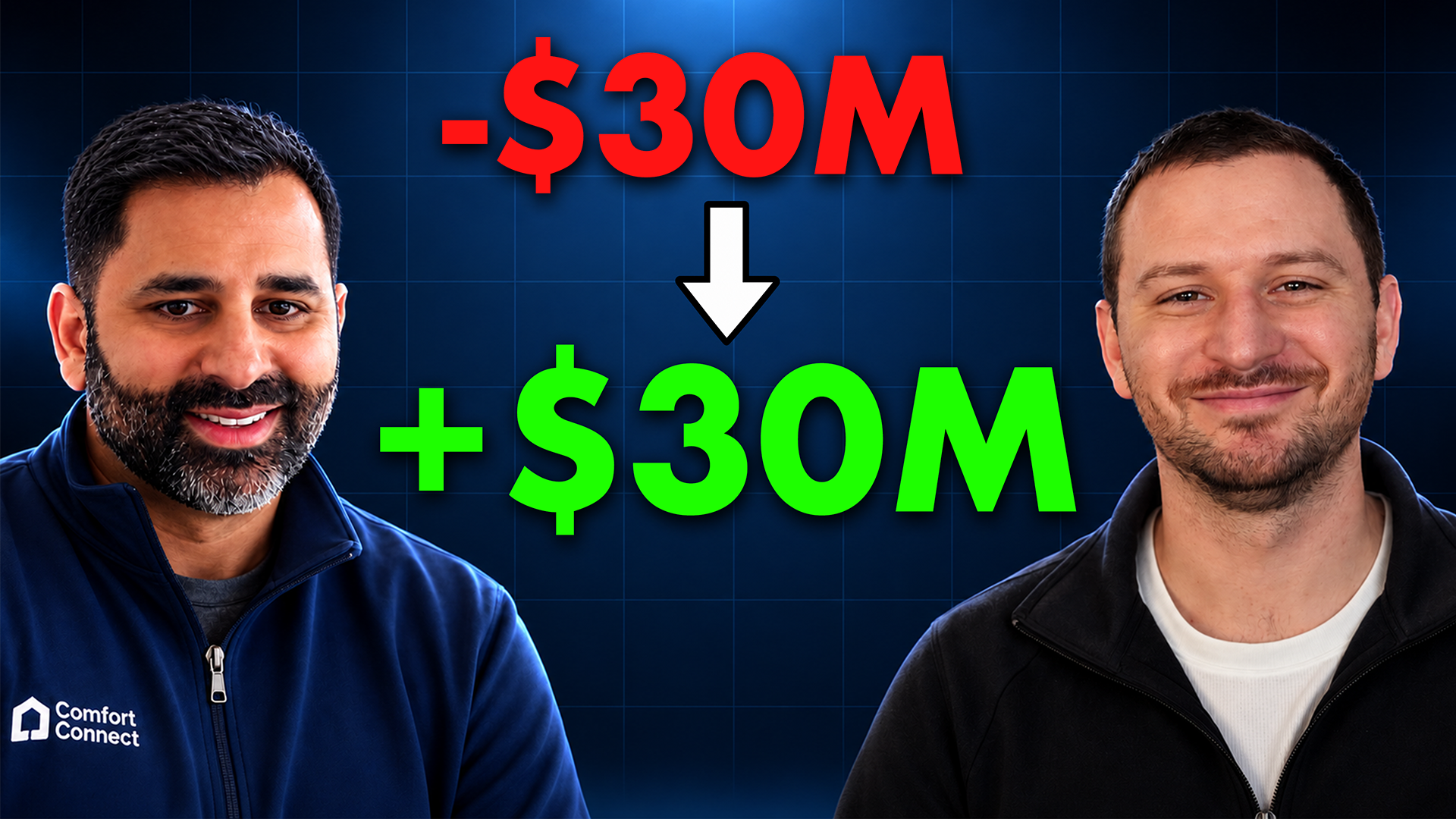
How do you turn a failing $500M home service company into a profitable business in just three years?
John Wilson sits down with the former operator behind one of the largest HVAC and plumbing turnarounds in the country to break down how Service Experts went from losing $30 million annually to generating $30 million in EBITDA across 110 locations.
They discuss the operational changes that made the turnaround possible, from restructuring sales compensation and cutting equipment costs to rebuilding local brands and improving customer retention.
Plus, why traditional HVAC maintenance agreements often fail, how financing and recurring revenue models can change the economics of a home service business, and what smaller contractors can learn from scaling and fixing a massive operation.
Whether you're buying, building, or turning around a home service company, this episode explores what actually drives profitability and long-term growth.
━━━━━━━━━━━━━━
In This Episode:
━━━━━━━━━━━━━━
• Turning a 500M HVAC Business 30M to +$30M EBITDA
• Why HVAC financing is becoming essential as equipment prices rise
• How leading with monthly payments can improve HVAC sales and close rates
• The difference between traditional financing, leasing, and subscription-based HVAC services
• Why some contractors finance 70–80% of their HVAC installations
• How to improve financing approval rates and track sales performance
• Why traditional HVAC maintenance agreements struggle with customer retention
━━━━━━━━━━━━━━
Sponsors
━━━━━━━━━━━━━━
Big Reputation
Get more from your Google Business Profile with Big Reputation. Automate reviews, improve local visibility, and turn more Google searches into inbound calls. Learn more: https://www.bigreputation.ai/oao?utm_source=oao&utm_medium=paid
━━━━━━━━━━━━━━
Connect
━━━━━━━━━━━━━━
John Wilson
https://www.linkedin.com/in/johnbwilson1/
Anuj Khanna
https://www.linkedin.com/in/anujkhannapremierprogram
Comfort Connect
https://bit.ly/4wGXqSX
━━━━━━━━━━━━━━
More Ways To Connect with OAO
John Wilson, CEO of Wilson Companies
Jack Carr, CEO of Rapid HVAC
📌 Disclaimer: Some links may include UTM parameters or affiliate relationships, meaning we may earn a commission if you make a purchase. Episodes may feature sponsors, but all opinions expressed are our own.
I think a lot of contractors don't understand that the consumers changed. We've surpassed every affordability threshold for most Americans. And so the need for innovative financing mechanisms is growing rather rapidly.
I feel like that's right.
And I said there's got to be a better way to retain these customers and maximize the lifetime value of that customer for the contractor.
Clearly, this is becoming an issue.
For multi-trade contractors, this type of like worry-free hold-home approach can be extremely valuable.
What was the biggest learning lesson?
The two biggest learnings I had were.
So discovering how to finance new ways to bring on financing partners is a pretty key part of our growth at Wilson. So we're excited for this episode to learn sort of what we can do better. Before we dive too deep, I do want to mention our catalyst event, May 3rd through the 5th. It's in Akron, Ohio. We're going to have around 100 operators coming in from all over the U.S. to dive into awesome topics like marketing, sales, and how to scale your business. If you want more information, check out ownedandoperated.com for more. All right, Anoj, welcome to the show, man.
Thanks for thanks for having me on.
Excited to be here, John.
Yeah, this is gonna be uh this is gonna be sweet. You're the CEO and founder of Comfort Connect. I would love to just to explain that project a little bit more for everyone because I think it's a pretty like unique way to think about financing. So I hopefully we can just help everyone get there so that way they it makes sense for the rest of our conversation.
Yeah, no, absolutely. Um let me give you some background on myself. So I'm a I'm actually an investor by background and training. So have spent most of my career actually doing distressed and turnaround investing, and that's what brought me to the trades. Um back in 2013, well before this big consolidation boom, you know, in home services, um, I led an investment where we bought at that time the second largest residential HVAC and plumbing um platform in the country from Lennox, actually. It was a business called Service Expert Heating and Air Conditioning. So at that time, in 2013, uh it had about 110 locations and about 500 million of revenue, but was losing a ton of money. And given that my background was in distress and turnaround investing, we bought the business and I spent the better part of four years working knee deep in that business from 2013 to 2016-17, um, restructuring it, returning it to profitability. So learned a ton about the space. Um, we did a bunch of basic blocking tackling restructuring work. We, you know, that sounds like so much fun.
Yeah, like to be honest with you, like I don't know. I've uh my turnarounds have been smaller, but like there's something to it. Like, I think I've I think there's people that just like they run towards shit like that, and there's people that run away. And I just dude, I just run towards it. Like I think like I don't know. So okay. Continue. That that's like that's like my uh happy place, is like give me the messiest, most fucked up situation, and uh I kind of want to figure it out. I don't have the time to basit all of our Google business profiles, so we started using Big Reputation. It keeps your profile active by managing reviews, responding quickly, and giving Google all the signals that your business is active and trustworthy. In our first 30 days, calls from our Google Business profiles jumped nearly 27%, and jobs booked through Google were up 27% too, without our team spending more time managing. You also get a clear view of what's actually happening. You get review trends, customer sentiment, and which tax and locations are getting talked about the most. So it's less busy work, it's more visibility, and it's more inbound calls. If you want your Google business profile working harder without creating another job for your team, check out Big Reputation at the link below.
Yeah, I mean, I can tell you what you just said is exactly right. I mean, everybody saw that deal and everyone looked at it and they're like, we're not, we're not gonna touch it. Too much work, too much effort. Um, and we evaluated the transaction and said the the there are very deliberate steps we can take to return this business to where it should be. So we did things like we redid all the sales comp plans, made them 100% commission, we renegotiated a supply agreement, dropped our equipment pricing 25%. We rebranded from a national brand name back to the local brand names, the phone started ringing again. We brought an outsource call center answering calls in Canada for our southeast locations with Canadian accents back into the local branches, the customer service levels rose. I mean, we did a bunch of basic blocking tackle restructuring work, and we took the business from negative 30 million of EBITDA to positive 30 million of EBITDA in three years, and we sold it for over 20x um to a public and trading company in Canada. And so the reason why I tell that story is one, that formed kind of the genesis for why we started Comfort Connect in 2019.
Yeah.
But many people who may be listening to this may not know that just above the border, millions of people do not own their HVAC and water eaters. Yes, millions of millions of people. They actually rent them. And so when we sold the business, we sold it to a publicly traded company in Canada, and they bought us with one single goal was to bring that rental model to the United States. Now, I was doing some other things in my career, coaching high school basketball, taking some time off, and I saw the success of this model, and I said, I think there's an opportunity to partner with independent home services contractors and give them a new way to sell residential replacements at the kitchen table that is more akin to a service-based consumption model as opposed to a product-focused sale.
Yeah.
Right? And so that's kind of the genesis of Comfort Connect. Um, you know, one of the two things that I realized when we were operating service experts was we had 220,000 maintenance agreements when we bought the business. 220,000? 220,000 maintenance agreements when we bought it. That's kind of sad. We had this massive turnaround, grew revenue, profitability. When we sold it, you know how many we had? 220,000 maintenance agreements. We literally cannot grow the maintenance agreement base. And I said to myself, why is this? And I realized maintenance agreements are being used for the wrong things in this industry. We can go into more details of my perspective on that in a sec. But the second thing is I realized this is a very transactional industry. The sale to the consumer is very transactional, right? I market, market, market, get a lead, no heat, no cool, try to flip them, install a system. And the amount of revenue that contractors generate post-install of a new system over the next 10 years is extremely small on average. Yeah. And I said there's got to be a better way if we're going to spend all this money marketing to retain these customers and maximize the lifetime value of that of that customer for the contractor. And that was really the genesis of why we started Comfort Connect.
There was a company I got introduced to this concept uh probably a decade ago. There's a company locally here in Ohio, and I was in this like better business practices group thing with them. Okay. And uh their half of their business was replacing rented water heaters, which I had never even heard of at that time. Yeah uh for I think it's American Water Heater. Yeah, I don't I don't remember the name of it. But dude, these things were nuts. I mean, they were concrete water heaters. Have
you ever like seen this or heard of this?
Or I know American water heaters. I I had not seen the concrete heat.
So they used to be they used to be concrete. And apparently that helped, I think, like moving it, literally moving it from one location to the other. Like it was a real asset to them of like, hey, this water heater, like we're gonna physically move it for wherever and then service it. Um, but you know, a water heater that's not concrete, that's been filled with sediment for 15 years, is already its own level of heavy. Now just imagine it concrete. So it was uh it was kind of funny. Their operation, it took four guys to get a water heater out of the basement, and they did 10 of them a day. It was just a machine driving all over Ohio just replacing these freaking water heaters. Anyway, that was my first exposure to rented, you know, home maintenance. But I think they do it a lot in water filtration, is my understanding. A ton of that equipment out there is rented. Yeah, uh, it just hasn't quite made it to HVAC in the same way it's it's popular in water filtration, I think is a good example.
Yeah, yeah. No, I think I think you're right. I think in the US, um, American Home Water Heaters has been around for some time. They were renting water heaters. From our perspective, the genesis now is a little bit different than historically. Before it was still about the equipment, now it's about changing consumer behavior. So if you look over the last five to 15 years, consumers have moved away from buying products.
Yeah.
And they're and they're more comfortable and accustomed to, hey, I'm just gonna either subscribe or pay monthly for access, use, and control to that product without the upfront costs or the risks and burdens of product ownership. So, like if you look at the if you look in the the entertainment industry, for example, we used to buy DVDs and CDs, what do we do today? Yeah, we don't own a single piece of entertainment. We pay monthly. We have access, use and control to the entertainment, no upfront costs, and none of the risks of me breaking it, scratching it or anything else. That's happened in a bunch of different industries, the transportation industry, the health and wellness industry.
Peloton's a good example. I mean, it's sort of like there's a bunch of these examples now where you like uh the UR ring, where you buy a $400 thing and then you pay $10 a month. Uh and maybe that's maybe not as good of a comparison because you're not renting it, but I think people are getting used to the hardware plus uh you know plus subscription more so than they were, yeah, to your point, five or ten years ago.
Yeah, so there's a bunch of business models like you mentioned, like the Aura Ring, where you you buy the product and then you subscribe. But the other model, like you said, Peloton, for example, they used to sell bikes and then have you subscribe, just like you said, for monthly content service. Now they're giving you the bike, giving you shoes, giving you the weights, and giving you the content service $99 under a lease contract.
Really? I didn't even know that. Yeah, it's kind of wild, actually. I mean, it makes sense. Uh it makes sense because like it's it's $2,700. Like that's a ton of money.
Correct, correct. And yeah, that's interesting. For our industry, as the prices of these systems have skyrocketed over the last five years, we've surpassed every affordability threshold for most Americans. And so the need for innovative financing mechanisms is growing rather rapidly, where not only you solve the upfront cost, but then you certain you solve the ongoing responsibilities of ownership as well. And that's where this kind of home comfort is a service option comes in.
Yeah, it's a car now. It's basically like $20,000 and there's shit to do every year. Exactly.
Exactly right. Yeah. And what did the car industry do when this happened? They went from financial, right? And so this industry's, you know, in in our opinion, gonna be no different.
How many, um, how do you measure like hit rate on this or success rate? Uh, because I'm I'm imagining this is changing, it's not really changing consumer behavior as much as it is changing dealer behavior. Like, are you willing to talk about a lease, which I think is probably you know, we've we've interviewed people um who've worked at uh places that had like a leasing, I don't know if it was yours or not, but like a leasing style of product. Yeah, and uh they the legacy dealers seem to struggle with that. Yeah, they still struggle with the concept of it, but I don't really understand why they would struggle with it because they're probably leasing their car. Like it it's to me, it is like the same thing. The Peloton thing is another good, I didn't even know they were doing that, but yeah, um yeah, the but I why wouldn't this be different? Like rent to centers lease sofas, so I you know who cares?
Yeah, so I think the the the reason why some contractors and some sales professionals struggle with this is because leasing in this industry has been associated with rent to own, which is for deep subprime, don't have any credit, don't have the cash, can't get approved anywhere else.
Okay.
Whereas this is like the highest value sale a contractor can make and the highest value service a contractor can deliver to a homeowner. So just to give you a sense, the average credit score on our program nationwide is a 760.
Oh, that's interesting.
Right? So these are not homeowners that can't afford it. These are homeowners that value cash flow, convenience, complete peace of mind. Rather than giving you 15,000 or 20,000 for a box and then being responsible for that box, they'd rather say, hey, you put a brand new system in my home. I have full access, use, and control of that system. You're gonna take care of all my maintenance, all my consumables, full parts of repair coverage, all for a monthly payment that fits within my family's budget, same as my family's cell phone bill or my cable internet bill. So I think a lot of contractors don't understand that the consumer's changed. And not everyone cares about, hey, I just want to own it, I want to own it, I want to own it, because most people don't even know what brand they have in their home of their water heater or their HVAC system, right? The other thing I would say is this industry, as you know, um the workforce is aging. And so people have done things one way for decades now. And so getting them to change not only them their mentality, but actually their sales process in the home and what they offer is probably the biggest challenge. So what we find is contractors that are most successful are the ones that are good at change management, right? How can they build a case to their team that this is our most valuable sale and the most valuable sale for the homeowner? And it's not going to be 100% of your sales, but let's lead with this option as a key value proposition of our business. And if a homeowner just wants to own it, let's just sell them the system and move on, just like we normally do today.
Well, so what happens with back on the like credit thing? Because I think you're right. So what happens in um is it what's the minimum? The minimum dollar amount? Um, sorry, minimum credit score to get approved.
Yeah, great question.
Is there like a subprime option or like not even?
Yeah, so we have two programs. One we call our core program, we buy down to about a 660 credit score. Okay. Okay. And then we do have a buy down deeper, which goes as low as a 600 credit score. We typically reserve that for contractors that are driving a lot of volume on the first look, and we buy some of the kind of the worst paper. Um, but again, this is not a second look program. And because it includes maintenance and consumables and all this stuff, you know, the payments for somebody who's like poor credit, you know, doesn't have the the cash to do it, this program may actually not be the best fit for them. But who it is a really great fit for is those people that value the service. Hey, I need a new system, but I don't really care about the equipment. I just want a reliable, comfortable home, and I want somebody who's gonna care for that system over its useful life. And I'm willing to pay monthly for that, right?
That's it. How much a month is like normal?
So the you know the payment factor is roughly 141, 142, something like that. So like a $10,000 sale would be $140, $142 a month.
Yeah.
All inclusive for that homeowner.
Yeah, that doesn't feel like very much.
Yeah, yeah. And this is, you know, John, this is available not just on the HVC side, but you know, ducted systems, duckless systems, tank and tankless water heaters, water filtration, purification, and softening systems, and standby generators. So for multi-trade contractors, this type of like worry-free whole home approach can be extremely valuable.
Can we spend a couple minutes on the service experts thing? I'm actually like just curious about that.
Yeah, absolutely.
So 110 locations. Um like full uh like full US, right? I think they're everywhere. Uh USA and Canada, actually. Got it. Okay, how many locations are there today? Do you know?
How many do they have today? Yeah. It's more than that. Probably I'd say probably 150, if not more. Got it.
So the um when they switch back to local brands, because I think Service Experts was sort of a uh like it would that was one of the Blue Dot era roll-ups, right?
Correct, correct.
Yeah. Okay, so then when they switch back to local brands, I think I've seen I'm trying to remember Service Experts, and I believe like it has like the matched logo everywhere. It's just some of them have a slightly different name. That's Service Experts.
Yeah, yeah. So what we did was so the original roll-up was local brand names. Yeah. They then went to a national brand name with no marketing support. So Bob's HVAC turned to service experts, yeah. No marketing support. So, you know, in our diligence, we we saw the date that they made that decision and all the call volume literally went because there was no brand awareness. Yeah, yeah. So we just went back and said, Hey, Bob's HVAC, a service expert's company. And the phone started ringing again.
That's crazy. What do you remember average store revenue?
Uh nationwide for them? Yeah, it was rough roughly five million dollars.
Okay. Yeah, I've always wondered, and you know, this maybe isn't the uh moment for this, but like I've always wondered with like a rotor rooter or like, hey, when you have a thousand locations or five hundred locations or whatever, yeah, like what is a normal size? Which like so for five million dollars average, there's a few twenties in there, correct. And then a probably a bunch of tens, bunch of threes. Yeah, and like, yeah, we got there. Yeah, that is that is really interesting. And it was 100% HVAC. Was there any plumbing at all?
There was plumbing, yeah. So it's HVAC plumbing, and they did some light commercial as well.
Yeah. Like, what was the biggest learning lesson? I mean, I'm sure you had a ton, but can you give me some quick that to me that sounds like an adventure of a lifetime? Like, that sounds like 20 years of learning in like a year.
For for sickles like us, it's an adventure of a lifetime. For other people, it's a nightmare. Um, yeah. So, look, I think there's two the two biggest learnings I had were the industry uses maintenance agreements as a customer retention tool, but they actually don't serve that purpose very well. Okay. Um, and the reason for that is most of the industry goes in, we sell them a new system, maybe we throw in a maintenance agreement, and we try to get them to renew and renew, and every time we're in their home, we slap a $600 invoice in front of them. We're not really there to maintain, we're there to sell something new. And that destroys trust over time, and people cancel. Now you're right back into this market, market, market to try to get the next service call to get the next replacement.
Yeah.
And I and I say there's gotta be a better way to do this, right? We're spending all this money on marketing, we're getting them in the door, we're doing the second, third, fourth largest purchase a homeowner will ever make is probably their HVAC system.
Yeah.
Yet it's so transactional. There's gotta be a better way to do this. That was the that was probably the number one.
And the second one was just the transactional nature of the way these businesses are operated. And so that's what we set out to try to fix with Comfort Connect with our worry free premiere program. Now, over the years, John, we've expanded what we do. So not only do we offer that worry free, all inclusive program, but we're a single point of sale waterfall financing platform for contractors that includes the Premier Program, first, second, and third look installment loans, and deep subprime lease to own. So we're seeing the need not only for financing growing, given tickets are going like this, but incomes are staying flat. But we're also seeing like a segmentation of the financing providers out in the market where no one financing provider in the market today can serve a contractor's needs up and down, right?
Yeah, no, I mean that's true for us. I think we have like five.
Yeah, five, but then five creates friction in that process. It's like, who do I use? When one declines, now you got to go to the other one, re-enter the information in potentially, and and so on. And then you don't have the data to look then across all your lenders and say, what is my true approval rate? What plans am I truly using the most? Right? What's the approval rate by plan? Which sales reps are actually driving the most utilization of financing and the highest tickets? Because now you're financing all fragmented across five lenders. One of the benefits of what we're doing is one point of sale solution, one credit application, and granular data across
all your financing, all the way down to the rep level. So you can look at it and say, wait a second, my rep number one is only financing 20% of their sales, rep number two is financing 80%, and his average tickets, you know, 30% higher. I need to be working on you know the first rep and try to get him to offer financing better and really start working on the training. We provide all that data through an AI hub that looks across all of the options that a dealer's using from us and can provide like approval rates and everything else by rep all the way down to the rep level. And so by consolidating that into one tool, it really helps dealers not only increase financing utilization, but then optimize for approval rates and dealer fees and things like that.
Do you know what percentage? Um my assumption is this the answer will come from like your experience and service experts, less so your active clients, but like either one's fine. Do you know what percentage of HVAC jobs are financed first paid?
Um just generally financed? Just generally financed versus like it's in the it's in the I'd say 20 to 30 percent range. It's low. Really? That's interesting. Because there's still a large, large portion of contractors out there that either don't offer financing at all. Yeah, yeah, or they have a financing provider, but they haven't built it into their sales process. So they're financing five percent or ten percent only when a homeowner asks for it. Yeah, yeah.
I I've I feel like that's right. I feel like there's a ton. I am surprised by twenty to thirty percent, but I do feel like that is a common thing that I hear is like, yeah, we've got this thing, but we don't really. Drive it into the business.
Yeah.
I was just on the for businesses that are like was it different at Service Experts or it or in a different like in a hundred million dollar company, like would you expect it to be different? Like, is it 50% of installs or like what do you what does bigger look like?
Yes, very, very, very different. So we were financing upwards of 50% in our price, and all of our large.
Yeah, I feel like our HVAC is like 70%. Like I feel like we like it's like the vast majority of our HVAC is financed.
Yeah. I mean, when we look, it's been a little while, it's been over a decade, so tickets weren't as big, et cetera, et cetera, back then. But like all the big players today, even the big independents, they're financing upwards of 50% of their of their HVAC tales. And many are doing 70, like you said, 70 to 80 percent. But the reason for that is not necessarily their consumers are any different, it's just their sales process leads with monthly.
They just offer it more. Yeah.
Yeah, and they just offer it more, right? It's built into their sales process. It's not left up to the discretion of the individual sales rep on whether to offer financing or not.
Yeah, yeah. I that makes sense. But yeah, I feel like I've heard that a lot. Just as we um like we're actively buying companies and during digital, that's a frequent one. It's like, well, how often do you offer financing and what does that look like? Um it is kind of funny because like legally, if you have financing, you have to offer it to everybody, which like that that concept does not seem to land for a lot of contractors. So uh and it's like it's just like anti-discrimination laws. Like you can't discriminate. Yeah, so um, but you can't discriminate on either direction, right? Like you can't discriminate because you think they're poor, you can't discriminate because you think they're rich. And uh and contractors always fuck up one of those two. They're like, oh, he doesn't need financing. It's like, dude, like that that's still discriminate, like no matter what. Like that is actually legal.
Correct, correct.
Which is uh it's kind of funny. But that's how you get tight on offering it is you just like explain, like, hey, this behavior is like we could get sued and they would win.
Correct.
Yeah. And I honestly, like, whatever it takes to get the team to offer it, I think there's so much upside to dealers going from you know five or 10% penetration to 50 or 70% penetration from an average ticket and closing rate perspective that whatever it takes to get your team to do it. Um, and that's one of the things we work on with dealers is like we have a learning management system in our platform, you know, helping them understand how to offer financing, when to bring it up, how to respond to common objections. So we're really big on training as well. Um, and we think you know, financing today is extremely important, but two, three, four, five years from now, it's getting more and more important because there's a gap and it's a widening gap between incomes and the price of these systems. It's only getting bigger.
Yeah, I mean, totally. I I it it is kind of funny. I think um it's funny to watch uh so like we're we're on a year and a half of like a rough HVAC market for most of the country. Yeah. And like it's you get to watch quarterly earnings from like Carrier and whoever else come out, and like it's never good, right? It's not like, yeah, we did amazing on the resie side. And um, and then like immediately followed by here's a 15% price hike, despite like their rapidly declining market share. Yeah, and it's like, guys, maybe we should go the other way. Uh, because clearly this is becoming an issue.
Yeah, yeah.
And like, yeah, so it's sort of like a self-fulfilling prophecy. Like, hey, the beatings will continue, aka price increases, until we get more market share. And it's like, well, I don't I don't know, I don't know what to tell you here because it doesn't seem to be working.
Yeah, yeah. No, no, no, you're out, you're absolutely right.
I would love to just add a little bit more sprinkling of operations in, just because I think it can add some value to people. And maybe how to adapt a sales process or like what do you think?
First and foremost, you know, when you when you talk about your independent dealer, call it anywhere between one and twenty million, um, and why some of them struggle with financing or they don't drive a lot of financial utilization. I think first and foremost, it's do they have a sales process in place? Right. And when I say sales process, everyone's like, yeah, we have a sales process. But when we talk sales process, it's literally what do you do when you come to that front door? Are you putting a mat down? Are you putting your booties on inside the house or outside the house? You know, once you get in, how are you greeting the homeowner? You know, are you doing discovery? And, you know, do you have a sheet that leads your discovery, you know, at the kitchen table? There's a variety of different things. I think having that sales process in the first place is probably a really big step for a lot of contractors. They don't have a clearly defined process that their team understands and that their team reliably follows, right? And I think that's the number one thing that can that's a precursor to financing is having a clearly defined sales process. I think number two is leading with monthly payments. Even dealers that offer financing and have a clearly defined process, most of the time what we see is they're not other than the big ones, they're leading with it's $12,000 or $140 a month. It's $14,000 or $160 a month, as opposed to just leading with the monthly payment. Um that's another big thing that we see, you know, kind of smaller independents really not fully buy into leading with the monthly payment. And it typically comes down to um, in a sense, they're spending the customers' money. Like you said, you know, this guy doesn't need financing, so I'm just gonna offer him cash. Well, we don't always know what's behind the scenes. And the benefit of the financing programs, at least that we offer, is that there's no prepayment penalties. At any point in time, if they win the lottery, they get an inheritance, they get a bonus or whatever, they can always pay it off early, no harm, no foul. Right. And that goes that goes for the premier program as well. Um, I think the other thing from an ops perspective is just is the data. And I kind of referred to this earlier is that we talk to contractors probably 20 or 30 a week, and the vast majority, John, are are very similar to Wilson's, where they have like five financing providers. But the the downside to that is not only operationally, your team doesn't always necessarily know what's the best option to use for that homeowner, but also how do you take that utilization, the data, and then make informed decisions on it? And if it's spread across five different you know providers, many of which don't provide you the information that you really want because they don't want you to see it, like approval rates, um, it becomes very difficult to improve your financing utilization if you're if you don't know your approval rates. On every single call that we have, I ask, what do you know what your approval rate is with whoever your lead lender is? And I would say 95% of people that I talk to don't know. Yeah. Right? And it's probably the single most important thing for financing is the approval rate. And 95% of the contracts we talk to don't know. And so I think that's a good thing.
It's not presented in like a cohesive to be honest, the the only way to get it for most of them is uh literally go count. That's what we have to do. Because everyone will tell you, like, hey, we're at 85% approval rate. Well, okay, well, you're approving us at 51, so like walk me through the gap here. Yeah. Uh, but yeah, we have to manually go count it.
Yeah, and so I, you know, I there's a reason for that, is because most lenders are first look lenders and they don't want you to see that. Wait a second, you're only approving 60%. Our approach is very different. We take a transparent approach and we're gonna give you all the data. We're not even gonna tell you not only what your approval rates are, but if they're low, we're gonna also associate a median credit score, an average credit score with that, so that we can show you that, like, hey, the reason why your approval rates are only 60% is because the average credit score is a 680 and you're sending second look business here, you shouldn't expect anything higher, right? And so we're gonna share a lot of that data so that you as a contractor can make informed decisions on how do I improve my financing utilization. And then I think the last is just making sure you have the right, from an operational perspective, the right financing partner, right? Some of them are more leading with I have the lowest dealer fees, some are with the highest approvals, some are I'm gonna provide the highest level of support. Different dealers need different things, and so I think finding that right partner that fits with a contractor's needs um is something that's overlooked.
Yeah, no, I agree with you. I think that we didn't um this was probably one of our bigger learning curves as we I don't know where it happened, maybe around 20 million or so. Yeah, we realized how much financing, and that's why we have five partners now, is at the time we only ever had one, and we just didn't understand how much of our business was reliant on just approvals. Yeah, and it is it's uh it which is like good and bad. On one hand, like, yeah, there's a bunch of resources to sell shit now, but on the other hand, it is one of the few things in your business that is just out of your control and is so fucking annoying. Because, like, hey, maybe the reason well, we found out, you know, for that one that we were at 51% after a lot of like pushing and pulling and yelling. Yeah, um, well, hey, the average credit score that we put through their financing on on first look was like low sixes. It's like, well, okay, well, that makes set more sense to me. I also can't do anything about that. I mean, maybe like zip code, but like also if a if a lead comes in, we're gonna run that lead. So it's sort of um you need to know it, but it is uh it's a complicated one to change. Yeah. You know, I don't really know what to do about like credit score in Cleveland. Correct.
Yeah, look, certain markets are just you know, the credit quality is lower. And so in those markets, like you know, Mississippi's another area, there's a variety of different areas where credit scores are just generally lower. And so in those, that's why solutions like ours, waterfall financing solutions, that have dedicated lenders focus on certain areas of the credit spectrum are so important. Rather than having two separate tools that, okay, for my Cleveland location, I'm gonna, you know, use this tool, and for my other location, I'm gonna use this tool. No, you have one tool and it's gonna surface the best option for that homeowner based on their credit quality. Right? That's why it's super important. And we see the industry, I can tell you, you know, we're we're talking to OEMs on a regular basis. We see this industry moving towards like waterfall financing platforms with multiple financing options, up and down the credit spectrum, traditional loans, lease to own, and things like the premier all-inclusive premiere program.
Yeah. I mean, I think that's a lot like cars. Like I think while we were talking, I looked up cars. 83% of cars are financed, yeah. Which I I honestly am surprised by how low that is. Yeah, yeah. I really thought it would be like 95. Um, but yeah, I mean, there's a freaking bajillion ways to take down a car now, which is kind of uh kind of the whole point. And I think as HAC becomes higher and higher, it just becomes more relevant.
Yeah, if you talk to, you know, I don't know if you have background in a car business, I don't, but I've talked to a lot of people in the car business who sold cars or run dealerships. The one thing that they'll say is they had a multi-lender waterfall, right? And it was one application, and we're gonna get that homeowner approved one way or the other, right?
Yeah, yeah. So something is happening to get to make that car happen, totally. Correct, correct.
And that's exactly what what we're bringing to the home services
space because we realize that the home services space is actually facing the same challenges the auto industry did several years ago in terms of like the price explosion.
Yeah, yeah. What what do you think one to $20 million operator should be focused on?
Yeah, so you know, like as you're looking at, in at least in my mind, the industry today and the fundamental changes. There's AI this, AI that, you know, and so on, but then there's like larger themes of like price increases, um, systems getting more expensive, breaching affordability thresholds, um, and a variety of other things that are affecting the industry, um, in including consolidation. For your local independent, I think they have really three advantages that they really need to harness in order to be successful if they're going to stay independent for the for the long term. Okay. Number one is like local touch. So, from my perspective, my experience running a large business, as decision making moves further and further away from the field level, from the local branch up the organization, it becomes harder and harder to keep that local touch, not only with your employees, but with your community and everything else. So I think the independent has that at their advantage, that decision making is at their local level, and they need to really harness that to deliver a better customer experience. Okay. Because it's as consolidators come in, not always, but oftentimes what you see is decision making moves up the string away from what where the action is, and it becomes harder and harder to maintain that local touch. I think the local touch is what's going to win in the long term. Um that's number one. The second thing is actually the speed to innovate. Um small independence call it 25 to 50 employees, they have the advantage of being able to innovate and try things much faster.
In like half a second.
In half a second versus in a few years.
Or if you get like eight people bought in depending on wherever the whatever is. Yeah, it's it's very annoying. I find it very annoying.
Yeah, but like the 25 to 50 employee person can innovate and test and fail way quicker than a 500 to 5,000 employee platform. And so they have to, in my mind, to win long term is to capitalize on that speed to innovate and have that culture that we're gonna try new things to implement new things within this business, and we're gonna use that as a competitive advantage relative to maybe some of the consolidators that they're competing with. Um, and then the the third is is really a time horizon thing. A lot of the consolidators, not not you guys, because you're not you don't have a traditional investor group, but a lot of the private equity backed consolidation that's happening, their horizon is very short. And it's almost immovable because of fun life restrictions and things like that. So three to five years and we're out. And so that also causes decisions to be made that prefer short-term results over long-term value creation. Whereas your independent, that maybe it's a family business or it's been in the business and they plan to own it for the next 20 years, they have the benefit of a time horizon to make long-term focus value creation decisions and not have to be focused on short-term results. I think those are the three biggest things that, as an independent, I would really try to leverage those being my advantage because the consolidators have way lower equipment pricing, they have scale synergies across marketing and benefits and everything else. They can, you know, they can pay people more. There's a variety of other things that they can do as because of their scale. So, what are the areas where the independent has an advantage relative to maybe some of the big consolidators out there?
Yeah, no, that makes a lot of sense. Yeah, I agree, I agree. Uh, I agree with all those. I think um, I mean, obviously, we you know, we're not an apex of the world, but even us, we're uh seven markets now, and it is complicated. And I I've I think we've talked about this on this show. Like you can beat a larger company like us. Like you can often run, and we're not even that big, like we're only like 90 or whatever this year. Yeah. And like Apex is three billion, right? So uh so yeah, it is it, it's I agree with you. You can be nimble and like act way faster.
Yeah, absolutely. Absolutely right.
Yeah. Awesome. Well, thanks for coming on today, dude. This was a ton of fun. Yeah. Um, no, we I'm I'm wishing, I almost want to do like a deep dive and like we have to check your, but just like a deep dive into the turnaround of service experts, that would be fucking nuts. And maybe I'll just like come out to DC and like have a mic on you and not tell you and just like buy you a beer and like get into it. You know, because I think that would be that would be awesome.
Let's do this. Uh so uh if we can get Brandon to set up the training, I'll come out for the training and we can we can do it then.
That would be I just feel like that would be um that sounds like fun. Like in my second life, in whatever like my next stage of my career is, like I want to go take down the most fucked up turnarounds in the US in our industry. And like just that sounds like such a good time. Like, I dude, I don't know, man. I think I like pain, I guess. I don't know.
I think you're I think personally you're gonna see you're gonna see some of it in this industry. Um I'm already hearing about cracks in some very, very large businesses. Uh yeah. And so I think you're gonna you're gonna see it right in this industry also. So maybe maybe we can maybe we can partner and do something interesting there.
So yeah, hell yeah. Well, thanks for coming on. If people want to hear more about you, where can they find you?
Um, they can go to www.comfortconnect.com. Um and um, you know, they if they want to learn more about working with comfort connect, uh, they can uh fill out a form right there. Um, or they can always shoot me uh an email directly. My first name, Anuj, A N U J dot last name K H A N N A at Comfort Connect.com.
Awesome. Well, thanks for coming on today.
Yeah, perfect. Thanks, guys. Appreciate it.