


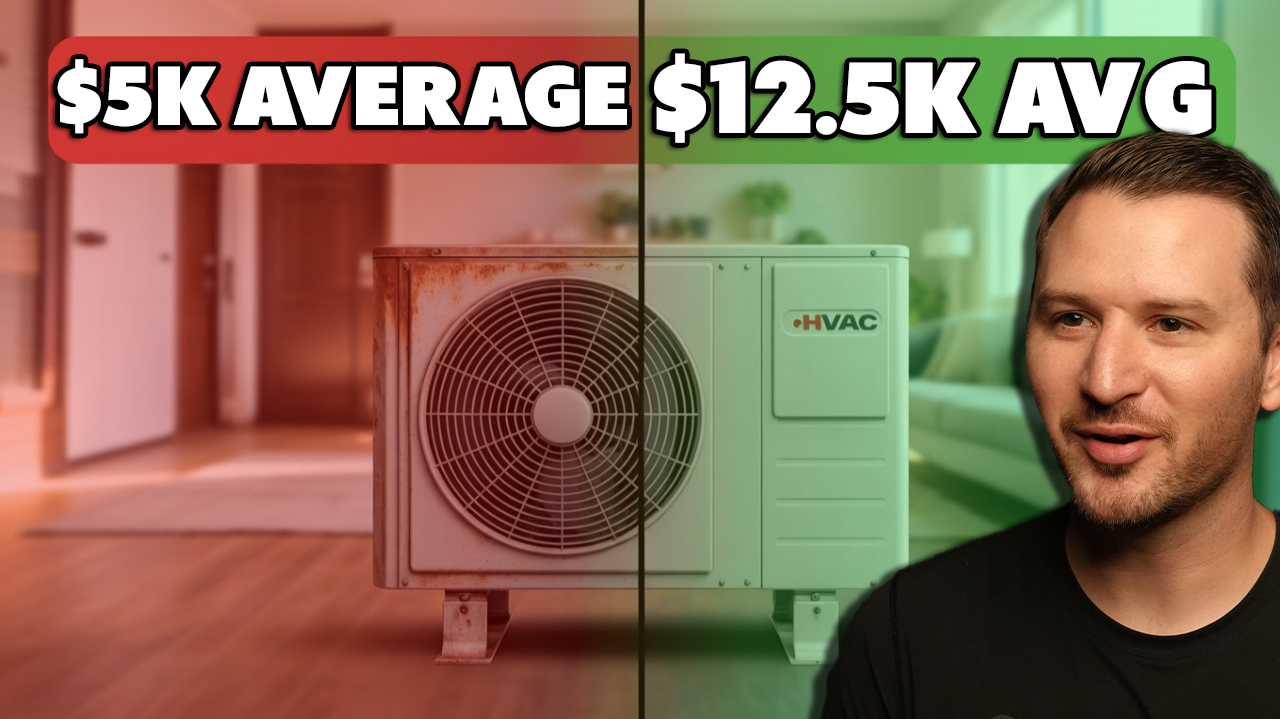
We break down how we tripled our HVAC average ticket—from $5,000 to $12,500+—and finally made sales profitable. In this episode, we walk through the painful mistakes, system overhauls, and process changes that turned HVAC from a money-loser into a real growth engine.
If you run a home service business, this episode is a masterclass in why “selling harder” doesn’t work—but selling better systems, earlier financing, and structured options does. We unpack how repair-first thinking killed profitability, why discount-driven comfort advising nearly sunk us, and how process—not unicorn salespeople—changed everything.
In this episode, we cover:
- The $5K → $12.5K Jump: How our HVAC average ticket actually scaled (and why it failed at first).
- Repair vs. Replacement: Why “fixing everything” was a disservice to homeowners and the business.
- Sales Process Evolution: From selling techs → comfort advisors → systemized selling.
- Software & Systems: How structured options unlocked premium equipment and IAQ sales.
- Financing Strategy: Why introducing financing early boosted close rates by 13% and added ~$6K per job.
🚀 What You’ll Learn:
- Why higher average ticket doesn’t automatically mean higher profit.
- How offering full systems (instead of single components) changes everything.
- Why premium equipment sells when it’s presented correctly.
- The biggest mistake contractors make with financing conversations.
- How process beats talent in HVAC sales—every time.
📞 Sponsored by Quo — The Modern Business Phone for Service Pros
Missed calls mean missed business. Quo (formerly OpenPhone) is the AI-powered phone system that logs calls, creates summaries, and automates follow-ups — keeping your team connected and customers happy.?
🎁 Start your 7-day free trial and get 20% off your first six months at
💼 Big Reputation — Stop chasing reviews and watching competitors outrank you. Big Reputation is the AI-powered review + SEO platform built for home service pros. Automate review generation, respond with AI, track local SEO, and integrate with your CRM. Setup is free, and your first month’s on the house.
🎙️ Hosts:
John Wilson: https://x.com/WilsonCompanies
Brandon Niro: https://www.linkedin.com/in/brandon-niro-957b86196/
More Ways To Connect with O&O
John Wilson, CEO of Wilson Companies
Jack Carr, CEO of Rapid HVAC
📌 Disclaimer: Some links may include UTM parameters or affiliate relationships, meaning we may earn a commission if you make a purchase. Episodes may feature sponsors, but all opinions expressed are our own.
OAO 273
[00:00:00] Today we're talking sales, like we weren't profitable really. We lost a ton of money. The problem was getting worse 'cause we weren't looking at things like conversion rates or how often they're flipping over to a sale in the first
place. So we went from 5,000 average ticket, and then now we're at 12 five and we're profit.
We're now putting in like premium top of the market equipment.
We just had to offer it our own data in-house. Yeah. So it's 13% higher close rate. Yeah. For technicians who offer financing before options are offered. In my mind, if you're using financing as a rebuttal tool to price objections, it's too late.
You're on an uphill battle. 'cause everything that you do to work against, that's gonna make it harder. Any closing
thoughts on improving hvac? It's, it's stupid simple, right? It's.
Welcome back to Owned and Operated. I am your host, John Wilson, and I'm here with my partner in crime, Brandon Niro. Together we run a $30 million [00:01:00] home service company in northeast Ohio, and for fun, we have this show that teaches other people how to do the same thing. Before we get much further, uh, my mom needs to know that I'm popular on the internet, so if you could either subscribe or give me a five star review on Apple or Spotify or wherever, it's that you're listening to this show, I would be really grateful and my mom would know that I've made it okay.
Today. It's good to have you back. Just had you on a couple weeks ago. We were talking about leadership. We were talking about training. Today, we're talking. Sales, we're talking that fat stacks of cash hitting the bank.
Nice. All right. Yeah. Thank you.
Thank you. Alright, so, uh, we have done Lord Jesus' work on our sales, that for sure over the past, uh, year and a half, two years, um, you know.
Like set the [00:02:00] stage a little bit. So we started taking h hvac, plumbing, electric, and like the sales side of it a lot more seriously. Uh, 2023 you think?
Probably, yeah. Right about, yeah.
I mean, nowhere near to where we currently are. Like now we have a sales trainer. We have like, it's a, you know, we're KPI driven?
Yeah. We're, it's a process. We're, we're a lot further, um, along than we were, but maybe I just wanna like talk about that a little bit. So when we. And like really focused. I think a, a funny way to think about this would be average ticket.
Okay.
So if we, and let's just talk hvac. 'cause I think that's the easiest.
So two years ago, three years ago, average ticket was, we could look it up. I mean, it was probably like.
Four grand, five grand. Wow. 4,500 ish bucks. Yeah.
Yeah. Yeah. And that's for HVAC equipment sales. So like, you know, for the listener, I think Nexstar tells us 12,000 or something like that is like, you know, where we should be [00:03:00] when someone's average ticket is really low, like ours was.
Then what we're probably looking at is like single piece of equipment. So I'm selling a bunch of like AC onlys or furnace onlys. Yep. And our job is to sell a system. Yep. So, I dunno, you wanna like, do you have any many memories of like what that. HVAC looked like when we started taking it more seriously.
One of the tools I've personally seen make a huge difference for service business owners is quo, formerly open phone. 'cause when you miss a call, you're not just missing a conversation, you're losing business Quo is the modern business phone solution powered by ai. It helps you stay responsive and connected it logs calls, creates summaries, and automates next steps from drag and drop setup to AI powered call tags.
Every detail is designed to make your phone system smarter, your customers happier, and your team more in sync. It's one of those tools that makes you wonder why you didn't already switch 90,000 businesses already. Start your seven day free trial at the link below and [00:04:00] get 20% off your first six months just for being a part of the owned and operated crew.
Whoa. No missed calls, no missed customers.
Yeah, I mean the, the problem really lied in exactly what you said, which was we were repairs focused, right? Yeah. And we would repair something. We have $2,000 repairs, like all the time, even more than that. I mean, we were averaging like $4,000 some on some days, and it was things that just shouldn't have been repaired.
Right? Yeah. That we were, yeah. That was just the, the mindset, right? It was, well, you could repair this thing no matter what. You could replace a heat exchanger who replaces a heat exchanger, right? Like you, you know, at that point we're talking a furnace replacement. So the mindset was very much on repairs, and when that couldn't happen, then it was, okay, this individual piece had to be replaced, this furnace, this ac.
Um, but we really didn't to look at the whole system, which frankly is a downside, right? We know that to the homeowner. That's where we the, I wanna say the aha is where we started realizing, okay, we're actually doing a disservice. Yeah. Yeah. It's
like kind of a wild disservice to Yeah. And what to at least not talk about [00:05:00] it.
Like, Hey, we can replace your heat exchanger, but. Why would you want to, that would be like replacing the engine in a 20-year-old car, like somebody might do it.
Yeah.
And like you can, but like we should talk about just buying a new car.
And this is the concept too of, you know, putting a brand new AC on top of a 25-year-old furnace.
Like Yeah.
You know, that furnace is eventually gonna go out. Probably sooner than later. 'cause we just disturbed everything Yeah. While replacing the AC and now that homeowner's gotta go back Yeah. Do that when they could have probably gotten a little bit better of a deal just doing the whole system in the first place.
Yeah. So that was where I, you know, the, the change started to occur is, okay, let's, let's start looking at this in a more holistic, it's better for the customer, it's better for us. It's an all around better experience for everybody involved. Yeah. We gotta change what we're doing.
Yeah. I remember designing the system that we used to sell, and this was like 10 years ago.
Mm-hmm. The idea at the time was, I was really concerned that technicians would, uh, 'cause it was selling techs. Yep. So like, not comfort advisors or salespeople or [00:06:00] anything. I was really concerned that technicians would like, take advantage of the homeowner and, you know, I almost, we almost like forced ourselves into this repair first mentality.
Yep. Because I was so concerned about the other side of it, uh, which. You know, I don't know. Lessons, lessons learned. I think most of it, um, like we've, over the years eaten a lot of like bad warranty calls. Yeah. Or like system failures because we repaired something and we never even, like, we've looked back at notes and we just never even brought up replacement.
So yeah. We definitely learned our lesson over the years of like, Hey, this is right for the business. It's also just right for the homeowner to at least talk about it. Yeah. Yeah, so when we first started selling hvac, um, HVAC was kind of hard for us to grow, but we did selling techs. Yeah. And I remember it was a very immature sales process, so we would hire a tech and like they would basically sell something.
And if it worked, great, if it didn't, okay. But like we weren't doing measurements, we weren't sizing stuff, we weren't doing good materialists. It was very [00:07:00] like, does this person know how to. Bring up the fact that this is an option and then will they give a price?
Yeah. And we really didn't even understand the process at the time either.
'cause we weren't looking at things like conversion rates or how often they're flipping over to a sale in the first place. It was just, if it happened to happen,
yeah.
Great. Then we would see what went from there. So then there was a, yeah, there's a lot of evolution that happened. Yeah. Through that. Yeah.
Learning, painful learning. Yeah. Painful learning. Yeah.
Um, then we brought on professional sales. Yep. And painful learning there too. Yep. Uh, the big stuff. So, but average ticket expanded. Yeah. So, yep. So we went from like this four or 5,000 average ticket to like 8,000, maybe 9,000 average ticket. We definitely started selling more systems, but like very low end, very, uh, like discount driven and like, we weren't profitable.
At all. Like really, we lost a ton of money, um, in the [00:08:00] process of expanding average ticket, which was a little, I think, disorienting for us at the time. 'cause it's like, well, average ticket just went up so much. How are we losing this much money?
Yeah. I remember multiple points through that misguided at the time.
But where we were debating about reeling back off of ca the comfort advising process altogether. Yeah. Back on selling tax. 'cause it was just like, what's what's happening? Yeah. This isn't working. Right. Yeah. And we. As fast as we were diagnosing it, the problem was getting worse. Yeah. So we were trying to solve through that whole thing.
Um, and what we found is just really the process, right. So we Yes. Unlocked a lot of things, but we didn't put guardrails in. So those,
it was still two person dependent. Yes. So like if, yeah, it wasn't a process and it was like this person is able to sell stuff at a discount. But like we didn't figure out anything else.
We didn't like get better as a business. Yep. It's just like we had someone that could sell stuff for less than a cost and we
put no guardrails, like you could do whatever you wanted inside of that. All we did was the [00:09:00] tech could get the flip. Mm-hmm. Which was great, and that process was starting to become a thing, but once the comfort advisor was out there, we didn't, again, had no process there.
So it was yeah, kind of a free for all. You could do whatever you wanted to do. I think in the moment, thinking back to that, a lot of it in the beginning was just like, this is amazing. 'cause the install team's busier than they ever have been. Mm-hmm. So probably blind to the. And
we didn't have, yeah, we didn't have like clean
accounting Yeah.
Reporting either. So it took some time for us to realize like the impact of how like, yes, it was great. Schedule was full, but holy crap, we are, yeah. We're losing our books. Yeah. It's leading. It's hilarious.
Yeah. So I think, um, so like still back to like process, we didn't deliver a consistent Yep. Um, process.
So. And that was like a couple years ago. And now I think I, I'd have to, I think average ticket last month was low again, but like low for us now is higher than it ever was. Like low was probably like 10 grand or something like that. And that's because we were doing like a [00:10:00] big, yeah, we were doing a big coupon during shoulder season.
Uh, but the past few months we've been like at like 12 five. Yep. Which is like the next RKPI. So we feel really good about that. I, I know people in the. High teens. I know a couple people in the twenties. I know some people at 14,000, but like for us, like 12 five was a really big accomplishment.
Yeah.
Um, that felt like a win.
And like it's more profitable than ever. Yeah. Like it's actually contributing and it's not like killing the business anymore. Yeah. Which is awesome. So like over the past, I'd say we got there in the past year. Mm-hmm. So what were the things that, like we did, so we went from 5,000 average ticket and that was just like.
We were just techs were just selling. Yep. Basically whatever. We went to eight or nine and that was like, we installed a ca but like not, no process. Mm-hmm. Driven and just like very discount focused selling stuff for less than it cost us. And then now we're at 12 five. We're profitable. So like what's the third evolution of our [00:11:00] sales look
like?
It sounds cliche. Mm-hmm. But it was systems and processes, right? Like we, we didn't have a good setup and we realized that and recognized that. Um, one of the things that I think was a benefit for us, we realized quickly after that that it wasn't going to be worth the time for us to come up with our own process.
We needed to find something. Was designed and built around it. Yeah. And that would, we could leverage instead of us coming up with our whole own process. Yeah. Yeah. That would've taken us forever long and we would've failed repeatedly and probably never successfully had done it.
Yeah.
So combining our processes that we utilize from nexstar, uh, and software as well too, to help with the tech side of things.
So, you know, sizing things correctly. Yeah. Understanding options on a more fundamental level. Yep. Um. That was a big step up there. And the software we ended up using, which thing was big help to as well as mantle. Mm-hmm. Um, that was a big unlock for us. And I, again, one of the things I thought was very important behind that was [00:12:00] we had, at the time, I think one ca Right?
And we were trying to figure out how to get more comfort advisors. I think we might've had two or three. Was it two or three? Yeah, maybe it was Okay. Not a lot. Right. And we had the lead flow for more. We were struggling to find a good way to get comfort advisors in who had all the technical capability and knowledge mm-hmm.
To quote those systems, um, understand the model numbers and things. I mean, to this day, there's too, too many model numbers out there, too many different brands. So understand what all that was just becomes complicated. So we needed the software to help ease that sales burden. How can we take someone who's sales oriented and understands the process and understands the value building?
And give them the tools to sell HVAC instead of trying to find someone who is wildly, technically capable. Yeah. And then teaching them how to sell. Yeah. Right. Uh, and that I think was the big, like that was the next iteration. Okay. So we can, we can hand this to literally anybody that we can trust in a home and we can teach them what they need to know to do the HVAC side of it.
We just have to know that [00:13:00] we can trust them inside the home. Mm-hmm. And give this process to them that'll work through.
Mm-hmm. And some of that proved, it ended up proving like. Wrong. Yep. Like, uh, and not to anyone's fault, but we did end up finding it easier to bring in industry. Yes. I think it leveraged a lot though as to
how to elite capable.
Yes. Right. Like we could bring a a tuneup tech. That is good in the home. Mm-hmm. And has just a base knowledge to it versus a 10 year experienced technician. Yeah. Right. Like the, the bar or the barrier to entry into the ca level drop substantially. Not as far as we want it to. The goal was obviously that 0% rate.
You could take car salesmen and make 'em that, uh, we tried that. It didn't work, right?
Yeah.
Uh, but we definitely were able to bring the bar down to a much more manageable level that our recruitment teams could actually
Yeah. Fulfill. Yeah. Fulfill and sustain. One of the, one of the funny things about this journey is like pure numbers, like we got better and we learned new things along the way.
And the most recent iteration, [00:14:00] um, is we, we drove process. Mm-hmm. With the help of software, with the help of internal training, with the help of, uh, external training like nexstar. Um, but we also, like, it created some new problems too, which I think is kind of funny. Like, uh, 'cause one of the things we wanted was like, how do we increase, it's called attach rate.
Mm-hmm. So how do we increase attach rate? So how do we add more indoor air quality, or how do we add more extended warranty or whatever, like in order to beef up average ticket.
Yep.
And, uh, it worked. Yeah. Like, sort of in a way to our detriment. Yeah. Because we didn't quite know, like the next iteration mm-hmm.
Isn't even like, Hey, our average ticket improved. It's more like, Hey, we're selling stuff like, this is really cool, but we're selling stuff we've never sold before. Yep. How do we do that? How do we retool our install team to be able to [00:15:00] handle Yeah. Like 26 SEER stuff. Yeah. Like they don't. We've never done that.
Heat pumps were an anomaly to us until this iteration. Right. Or like, uh, like communicating systems. Yeah. It, it went from like, you know, we went from like this discount driven, like everything we're gonna sell is 13 seer bottom of the barrel stuff to like, Hey, we actually install a couple communicating systems a week.
Yep. Like maybe one a day. Like it's a lot. It's a lot. And, uh, yeah, we had some warranty pickup, so I guess like, walk me through. We went from this sort of like low cost provider, the discount HVAC guy. Yeah. To, we're now putting in like premium top of market equipment. What did that look like? Your team's doing the work?
Big reputation makes sure that Google knows it. Some of the key areas they help are, if you have multiple Gs, they can post on every single one of them every day. They can send reviews by your closest GBP to wherever the job was completed. They have built-in SEO heat maps that show exactly where you rank on the map [00:16:00] pack in real time.
There's no more manual updates, no more missed opportunities, just results Get started free@bigreputation.ai and unlock 15 free SEO scans today.
Uh, ironically, way simpler and frankly on accident 'cause I don't know that we intentionally set out to do it. Our focus was increase the average ticket. We thought about things like iq, we thought about.
Um, full systems. Mm-hmm. Right. But even the seer rating, like getting just the higher efficiency systems in heat pumps, side discharge units, all these things that are easy average ticket increasing.
Yeah.
Um, they weren't front of mind at time. A lot of that came from, again, the software choice. Right. So, yeah.
When we introduced mantle into the team, a lot of that just started to happen because that's the process. I remember the first week, yeah, we just like sold a 20 something and we're like, what? Yeah, we sold an accident and it was like, oh crap, okay, we have to do this now to figure out how to do it. Um, but it's because the options were, it's, it's, it's stupid simple, right?
It's. We [00:17:00] just had to offer it. We weren't offering this stuff in the first place. Yeah. Yeah. We hadn't the price book 13 C Onlys. Right? Yeah. It's 'cause that's what you're comfortable talking about. Yeah. So you never put it out there. It's the same thing with IAQ. We never offered the IQ because you saw the humidifier and you left it there.
Yeah.
So people wouldn't think to, Hey, let's offer a new one.
Yeah.
Well suddenly when you go and you lay out, it's a 2,500 square foot house, it's two floors and here's the load calcs on it. This is what it looks like. Uh, here's the existing system. Yeah. Et cetera. It spits out everything from a 13 SEER up to 20 SEER side discharge heat pump.
Yeah. Yeah. Everything came included with a duct cleaning. Mm-hmm. Um, humidifier and uv. Suddenly that's right in front of the customer from the rip, right? Yeah. So we're not having to add these things on post fact. If they ask about 'em, we're just offering rid off the rip. Uh, that's where we started to see it from.
'cause it's, you know, suddenly mm-hmm. It's not you as the comfort advisor having to add them. It's there for you. So when you go to present from the rip, you're already offering those high-end products. You're already offering those [00:18:00] IQs and it's up to the customer to say no, not for you to upsell mid sale, the system itself already.
Yeah.
To become a much easier sales process. Probably some backend psychology behind that too, right? From the homeowner having to physically want to remove that stuff. They see it on there and mm-hmm. They have to be the ones that say no. Uh, we just saw that inherent increase from that too, right? Yeah.
We're suddenly now. Okay. Yeah. We got trained on iq. We have to train on proper UV installation. Mm-hmm. Um, side discharge units. How they function, what does it look like? Diagnosing those things during the install. 'cause they're things that we just have never
Yeah, yeah. Even done before. Yeah. Yeah. It became good.
Our next iteration will be kind of interesting 'cause we're expecting like, so, so we went through like a period of like, hey, this is new. Like what do we do now? Mm-hmm. Um, and now we have that figured out. Uh, like our install manager really like took that on. I feel like he did an awesome job. Yeah. And where we're at now is we're back refocusing on average ticket again.
Yep.
Uh, and like the way we think we're gonna get there is financing. So do you wanna share, I guess, like [00:19:00] where our current thoughts are on that?
Yeah, so the financing, uh, the conversation we're having now is around the total value of a system versus the total monthly cost. The entire thing is, you know, following car industry, right.
Standards there of homeowners, do they care as much about how much the upfront mm-hmm. Like this is the total of the system versus how much can I afford monthly? That financing is accessible to them. Yeah. And at which stage in the process do we introduce it to them? Right.
Yeah.
And the theory we're working off of now is the sooner we introduce that, the better, because we're going to already,
some of that's just from like our data, like we're, we're recording calls.
Yeah. And yeah. The earlier in the process, I think it's one we're more likely to close. Yeah. And two, the average ticket is like $6,000 more or something. Yes. If we bring up financing in the first five minutes, it, it's some like outrageous statistic,
our own data in-house, so I can't speak for holistically.
Yeah. But it's 13%, uh, higher close rate Yes. For [00:20:00] technicians who offer financing before options are offered. Yeah. Right. So historically speaking, people would like to go in and put that. Into their, uh, sales process. So here's the options. Here's what you have, here's your total investments, and these are what the monthly payments would look like.
So the, the theory we're working off of with the financing now Yeah. Is when we're looking at how soon that we offer it, the sooner we offer, the more likelihood that we have of a successful sale. Mm-hmm. Where historically we've thought about. We offer the option, we talk about total investment, then we talk about financing.
We already have a heightened customer, right? 'cause they're, they have that shock from how much that system's gonna cost. Now you have to bring them down through the explanation of financing. Yeah. Versus if we start from the beginning,
which things, Hey, we have a ton of great financing options. Yeah.
Yep. We are ready.
Bring the barrier down. And then when we're in the present presentation steps, for example, like how we use mantle. Mm-hmm. The very first thing that the homeowner sees. Is that financing option? They're gonna see the best finance financing option we have out there. Mm-hmm. So before they can [00:21:00] even see that total investment cost, it's $20,000.
We're already bringing those barriers down by seeing, oh, it's $125 a month. Yeah. Once we then talk about total investment, we're no longer through that shock and a right. We've now justified, okay, we can afford, we're in budget for $125 a month. That's okay. We can process that.
Yeah.
We wanna know the total investment.
We still wanna be transparent about the things. It's much easier to have that conversation after. We've already justified what we can afford inside of that. Yeah. So the process that we're going through now is how do we make sure that every time we're in front of a homeowner, we're having that conversation and we're using that process upfront, talking about that as we go through those presentations and leading up to it.
So we're prepping the homeowner for that so that way we can have a better and more successful closing process. I
haven't bought a car in a while. Mm-hmm. Um, like how early does it, or, well, I guess most of the advertisements are like, yeah, check out the, so really like. Even pre-experience, like someone's got financing on the brain.
[00:22:00] Yeah. And that's part Exactly. They have financing on the brain. And the other side of that too is how enticing is the financing now, whether or not they qualify for it. Right. It's what's getting them in the door to talk to you. Yeah. Um, I say this all the time as we're going through this theory now. Is we're trying to mimic the Ford concept, right?
Yes. Yes. That 72, uh, months, 0%. People see that whether they can qualify a for it or not, it's getting 'em in the door to talk about it because nobody else is offering that. Yeah. It's pretty nice. Yeah. And that's, again, will be unique for us currently. 'cause the best thing we've found competitive locally is in the 48 to maybe 60 months.
Mm-hmm. Very rarely, 72. Frankly unheard of around us. Yeah. So being able to offer that, uh, the way we're treating that is you get financing promotions or you get special pricing.
Yeah.
So leveraging that through the software, we're able, the very first thing they see is they're seeing that 72 months, 0%. Yeah.
And that's just a wildly attractive monthly payment for them to see right off the rip. Mm-hmm. Which is just setting us up better to handle any of the other objections that we have. Come down the line there. Yeah. Okay. And it, when you start to see that, right. 72 months, you understand. [00:23:00] What that is. Then the technician or the comfort advisor gonna have that conversation.
They're thinking about the iq, right? Mm-hmm. We're talking 72 months, 0%, that iq. We're talking $5 a month difference, right? Yeah. Now, it's much easier to talk about those add-ons in there because what's five bucks a month? Yeah. Versus a thousand dollars upfront cost, right?
Yeah. Yeah, this will be interesting.
It'd be fun to watch. Like I, I think what's been interesting is our sales process has developed like one average ticket's obviously expanded quite a bit. We're up from like 5,000 to 12 five. We're now like probably gonna be in the 14 fifteens. Yeah. With this change, like it should be a meaningful impact to the business.
So hopefully tripled the average ticket in four years. Yeah. Um. And almost all of it through like process, uh, not like finding unicorns, but like, do we deliver a consistent process? Yeah. Can we repeat it? Well, the, the, the interesting like separation mm-hmm. Is now between marketed leads and like tech generated.
Yeah. [00:24:00] Because our average is 12 five, but our average for marketed leads is like 8,800, or it's like a very, like low competitive but average for. Tgl LS, I think is in the fifteens. I have to pull it. Yes. But like it's, it is kind of significant. Um, yeah. So what I'm expecting to happen, I don't think our TGL average ticket's gonna change much.
Yeah. Like, it'll probably bounce up a little bit. I think where we will see the most lift is our marketed Yeah. Leads. 'cause we're gonna come in like hot and heavy with like a, a new financing promo that Yeah. Other people just don't have or can't afford.
Yeah. Yeah. But again, I think even with the financing promotion.
Even if you can't get your hands on a 72 month, it's how it's executed.
Yeah. Yeah.
When are you talking about it? At what stage in the sales process, even if you can't get your hands. 70. What about 60? What about 40 eights? Yeah. What about 36? Doesn't matter as long as you've got something to work off of.
It's At what stage in the process do you bring that conversation up? With the homeowner? Yeah. In my mind, if you're using financing [00:25:00] as a rebuttal tool to price objections, it's too late. Like you're on an uphill battle. Yeah. And you're not trying to justify your cost versus you've already warmed the lead.
Yeah. The entire time through that process. So it's seeing it, bringing it up during the, uh, the value build, during the rapport build with the homeowner. Then during your presentation step, like you should not be presenting. Your total investment prices before your financing prices. Mm-hmm. Right? Because everything that you do to work against, that's gonna make it harder.
Yeah. So the better that lineup is in the beginning, whether it's a amazing plan or just your standard financing is gonna help
in that process. Yeah. Yeah. Agreed. You know, this will be fascinating to do, like a six month from now, check in on average ticket and see where we ended up landing. Yeah. But yeah, my guess is like 14 to 15, like it should be like a big uptick.
It should be. And again, we've seen it so far, even just with our, uh, TGS did go up in general as well too. Process. Yeah.
Switching over from like CAS to our current model was like a dramatic average ticket change.
But that's part of my caveat. I think as to why I like the out of industry on [00:26:00] this, our. S the A flip process we have for our technicians.
Right. Is that over the phone sale with the inside sales rep? Yeah. They're not HVAC tech by nature.
Yep.
So they just trust the mantle process. Right? Yeah. Mantle says, put these IQ on here. Yeah. Put this on here. These are a HRI matchups. Mm-hmm. These are guaranteed to work systems for that setup. Mm-hmm. So they just trust it versus like that backend.
Well, I've been a tech in the field for 10 years. Yeah, I know. It should go in here. Yeah. They're trusting the information that's been provided, that mantle's gonna provide the right output and then they're gonna roll off of it. So, yeah, it's, that I think is why we've seen a higher tick in there as well too.
Because if you look at a CA versus the inside sales mm-hmm. IQ is never removed. It's just always assumed that it's gonna be on there. Yeah. 'cause it is, it, it sells because it's really a non-question to the homeowner. Right. So it's, yeah. Do you want clean air? Yeah, exactly. Yeah, for sure. And that's been a, one of the side effects or one of the benefits we've seen.
From that process in conjunction with
mm-hmm.
Everything else.
Yeah. So as we're [00:27:00] prepping to go from like 12 five to like 1415 mm-hmm. Uh, what we've learned is we've driven process is like how. Frequent and effective is our coaching and our training, like sales training, but also just like training in general.
Yeah.
With our cas and like how are we measuring and what are we doing to continue to improve? So like what, what, what does that look like for us now? And what do you think it's gonna look like?
Yeah. I think the, so the tools of the trades, I think what has been a good, um. Changing point for us, right?
Mm-hmm. Where before it would require ride along with those comfort advisors to really understand what's happening. And even then, you're getting a short glimpse of this. Yeah. The softwares, I'm just gonna use the mantle as the example here that we're Yeah. That we utilize in this, is we're able to get more in depth understanding is what's actually happening inside the home.
Yeah. Um, where homeowners are focused, right? Mm-hmm. We can see how that technician or how that comfort advisor went through the presentation with the [00:28:00] homeowner. And then we can understand where are they ed on, right? So if they don't close on site, if something doesn't happen there and the homeowner's looking at those quotes afterwards mm-hmm.
We have access to understand where are they going inside those quotes, what are they focused on. Mm-hmm. Um, comparing that up with, like I said, we record our, uh, conversations in the home. We can tie that. Okay. So why they focus so much on. This specific part, right? Maybe they're focused on specifically this 15 year option.
Um, what did the conversation look like inside the home so we can pair those two together, really understand were we the ones leading the conversations, there is the homeowner led there. Which can give us some information. How are we, how can we coach better to the comfort advisors? Right? Did we steer towards the middle of the road or did the homeowner go there?
How do we talk about our high end options versus the, the economy, low options there, you know, is that comfort advisor guiding the homeowners in those directions? Are we steering them away from them? How do we talk about the IQs inside of that? We can tailor those pieces together to really understand what's happen, [00:29:00] how it's
what's happening.
Yeah. And then we can talk, when you talked about like, are we removing stuff, are we not? Yeah. Um, and I think there's a rating. Yeah, there's a, you can like, yep. Yeah. There's a directly score or something.
Yeah. It's a, uh, the proposal rating. So it shows us how good the, uh, overall, the, let's say you offer five options, right?
What does the strength of that proposal look like? So did we offer a good separation between there? Maybe. Did they manually override. It's called the magic button. So it automatically gives you a good dispersion across the lowest tier system to the highest tier system that fits in the criteria. Right.
Did you go in and override those like price
dispersion or
price dispersion efficiencies? The whole bunch of factor that's in there. Right. So, so we're not just presenting like four options of 26 years. Got it. Yeah. So it's looking at how well did we set up those options? Yeah. And price alone, right? You don't want to have something that's 14,000.
14,200. Yeah. 14,500. The customer, even though if you explain the differences aren't gonna understand that. Yeah. They're gonna wanna see price differences. Yeah. They wanna see seer differences and understand, okay, there's an [00:30:00] actual difference here, not just a random dollar amount. There's no logic behind.
Yeah. So that proposal strengths gives us that, again, another coaching tool to say, are you using the system correctly in what you're outputting? Is it giving a good customer experience?
This was good. Any closing thoughts on improving hvac?
Process, process. Process. That's the biggest thing. I mean, honestly, it's lessons learned, painful lessons learned, but the, as our process has been more refined as the mechanisms that we use to move through that have been refined, it's been continued improvement and success.
Yeah, I think we'll iterate probably five or six more times off of this. As it just, we learn more of the details and what the homeowners are looking to see out of it. Um, but it's made a big, big difference. Yeah. Yeah. Huge difference. Yeah.
Awesome. Cool. Thanks everyone for tuning in. Make sure you gimme five stars wherever you're listening to this and hit that sub button.
.png)
.png)

