


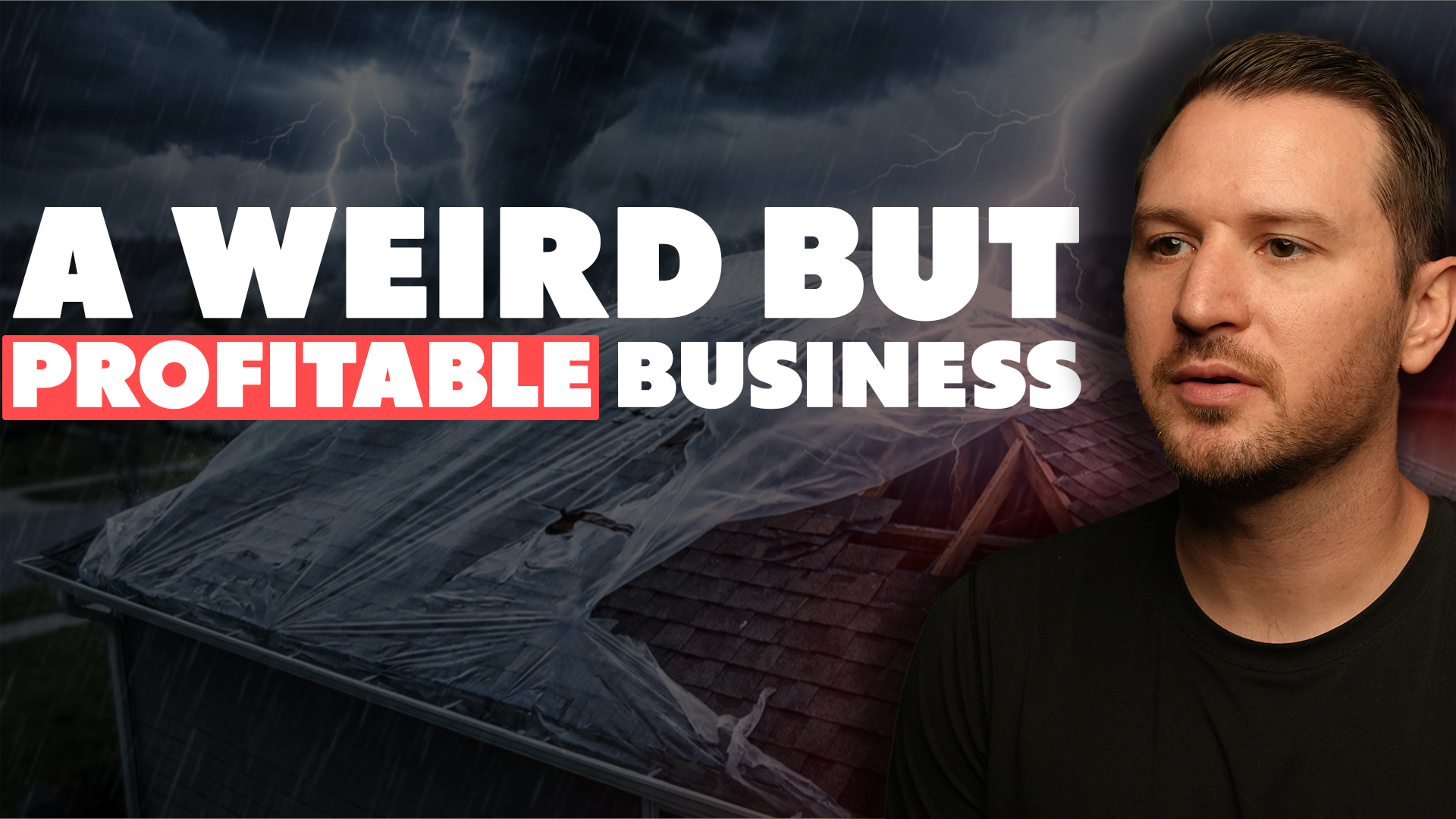
Most contractors think storm work means one thing: replace the roof, deal with insurance, fight delays, and wait your turn.
But in a recent conversation on the podcast with Adam Cher, I learned there’s a different business model hiding in plain sight. It lives in the gap between damage happening and repairs finally starting. And that gap is where buildings get destroyed.
A hurricane rips sections of roof off. Water starts pouring in. Dry-out crews can’t work until the structure is protected. Insurance adjusters drag their feet. Roof replacements take months. In commercial, they can take one to two years.
And during that window, the property doesn’t just sit there. It bleeds. Every week without protection compounds damage, increases claim size, and turns a roof problem into a full building problem.
That’s why roof shrink-wrapping is such an absurd niche. It’s not a roof replacement business. It’s a loss prevention business, and the economics are wild.
What Shrink-Wrapping Actually Is
Shrink-wrapping is essentially a temporary roof system that gets installed immediately after a storm. Instead of throwing up tarps that fail, shift, and need replacement every 30–60 days, shrink-wrap creates a sealed, watertight cover that’s guaranteed for up to a year (and often lasts longer).
It can be installed over:
- Hurricane wind damage
- Hail damage
- Metal roofs
- Tile roofs
- Even fire-damaged structures (material won’t carry flame)
And this isn’t some tiny emergency patch. Most of the time, you’re wrapping the whole roof. If one section is compromised, everything becomes vulnerable, and partial fixes usually create new problems down the line.
Why This Niche Works
The best niche businesses tend to share three traits. They solve a problem that gets worse every day, they’re expensive to ignore, and they’re hard to execute consistently.
Shrink-wrapping checks all three.
This isn’t about “fixing” the roof. It’s about stopping the next wave of damage from happening while everyone waits for insurance and reconstruction. If the time between initial damage and replacement stretches into months, the building can rack up millions in additional loss. So the wrap becomes less about price and more about prevention.
That’s why pricing holds. A typical house job can run $20k–$30k. Commercial projects often land $150k–$350k, and the rebuild that follows can reach hundreds of thousands to nearly $1M depending on scope. Compared to the cost of letting a million-dollar building rot for nine months, the wrap becomes an easy decision.
The Economics Are Better Than You Think
This is where it gets interesting.
Margins can run 60% to 80% depending on material costs and how well you operate. You’re not buying shingles, tear-off labor, disposal, underlayment systems, and all the other expensive moving parts that come with replacement roofing. You’re deploying a repeatable stabilization install.
The core inputs are simple:
- Plastic sheeting rolls
- Labor
- Fasteners (nails/screws)
- Propane heat shrinking
That’s it. You get a big-ticket invoice without big-ticket materials, which is exactly why the math works.
The Real Business Model: You’re Selling “Time”
Most contractors sell installs. This niche sells a calendar.
You’re giving an owner a roof that stays watertight while the real roof replacement gets delayed by insurance, adjusters, permitting, material lead time, and contractor backlog. They aren’t paying for plastic. They’re paying for the ability to wait without getting destroyed.
What they’re really buying is:
- Water intrusion prevention
- A stable environment so dry-out crews can work
- Protection while claims get processed
- Time to get bids, permits, and materials
- Confidence the building won’t deteriorate further
When you look at it through that lens, it becomes obvious why this niche is powerful. It reduces risk immediately, and that’s what people value most after a disaster.
How To Make Insurance Pay For It
Insurance doesn’t love the sticker price, but they love what it prevents. That’s why the best framing is “loss mitigation.”
Most policies require the property owner to mitigate damage. That means shrink-wrap isn’t a luxury. It’s what you do when you’re being responsible. The play is to install quickly, document everything, and bill clearly as mitigation so the adjuster has fewer ways to reject it.
The basic sequence looks like this:
- Install wrap immediately
- Document heavily (before, during, after)
- Invoice clearly as mitigation
- Submit with the claim
- Be prepared to justify scope
Adam noted a close to a 99% success rate getting paid when it’s positioned correctly, with the occasional one requiring legal follow-up. The skill isn’t arguing with insurance. It’s packaging it so the claim processor sees it as necessary and reasonable.
Who Should Consider This
This is not a niche you bolt onto a random construction business. It’s most naturally paired with roofing, because you have to understand water shedding, roof geometry, and how to tie the system into weird rooflines without creating new leaks.
That’s why the best model is internal: you run a roofing business, train a wrap crew, and deploy them on storm work. You can travel, wrap projects quickly, and then hand the long rebuild pipeline to local roofers when you’re outside your home market.
That single decision keeps the business clean. You keep the high-margin work. You skip the multi-year reconstruction headaches.
How To Start This The Right Way
If you were going to pursue this niche, don’t overcomplicate it. The fundamentals are straightforward, but execution matters.
First, you need to learn the install process properly, especially heat shrinking. Over-shrinking thins the material and causes future failures, which creates callbacks and destroys your margin. There’s a fine line between tight enough and too tight.
Second, you need a deployment playbook. Speed wins storm work, and slow operators get punished. That playbook should include your equipment list, crew travel checklist, housing plan, quoting system, and a documentation SOP that keeps your insurance reimbursement airtight.
Third, you need the right lead sources. This niche scales through relationships, not advertising. The biggest ramp came from working with a storm referral operator who pre-positioned clients like hospitals, schools, and government buildings. If you’re the vendor they call before the storm hits, you’re not competing with 50 random roofers after the fact.
Finally, if you can choose, go commercial first. Residential is fine, but commercial is where the math gets ridiculous because you can concentrate revenue into fewer projects with cleaner logistics.
What To Do Next
If you’re already in roofing, this niche is worth a serious look. Not because it’s glamorous, but because it’s aligned with reality. Storms create delays, and delays create secondary damage. The operator who shows up fast and prevents that damage wins.
Here’s your action plan:
- Identify 3–5 commercial property managers in your region
- Pitch “temporary roof stabilization” as a mitigation service
- Build a rapid-response crew plan
- Document how you’ll mobilize within 24–48 hours
- Position it as the solution between tarps and replacement
Execute this well, and you won’t just get storm revenue. You’ll become the first call after every storm. Who knows, you may even become the next Paul Reed, a roofing legend who went from local player to multi-million dollar roofer.
.png)

.png)